NFL London Games Weather Betting Strategies and UK Venues
 Available in US
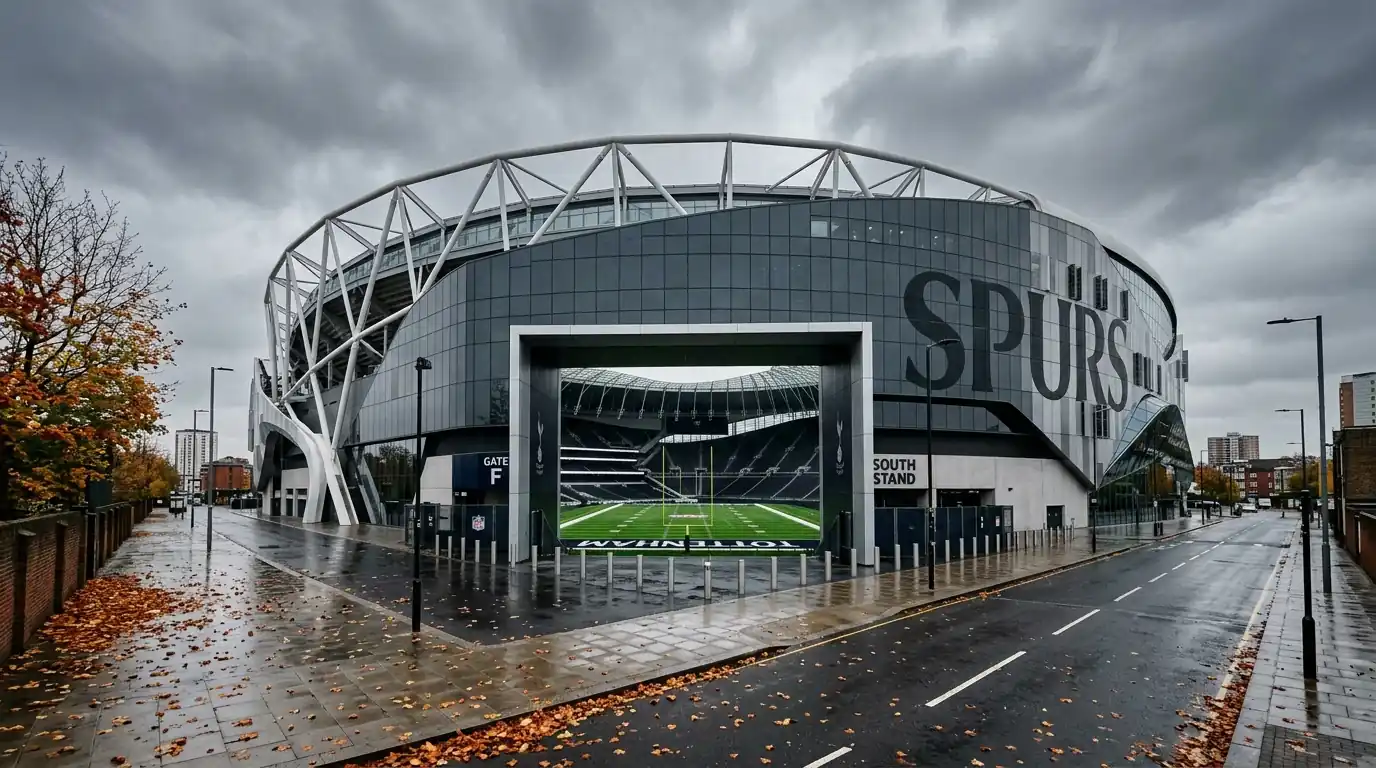
I was at Tottenham Hotspur Stadium for the 2023 London Games, standing in light October drizzle at 2:25 PM, five minutes before kickoff. The temperature sat at 14 degrees Celsius — about 57 Fahrenheit — with a gentle westerly breeze that barely ruffled the corner flags. Around me, 62,000 fans in NFL jerseys, the majority of them British, a remarkable number of them checking their betting apps. The NFL now counts more than 218 million fans outside the United States, and the London fixtures are where that international fanbase becomes tangible. Three games in London in the 2025 season, seven international fixtures total — a record — and the trajectory points only upward.
For UK bettors, London Games represent a rare opportunity: NFL football played in your own climate, on your own soil, with weather conditions you understand instinctively. Every other NFL game requires you to interpret American weather data from 3,000 miles away. London fixtures require you to glance out the window. That familiarity is an edge, but only if you know how to use it.
London Autumn Weather Factors vs Typical NFL Host Cities
London in October — when most NFL international games are scheduled — is mild, damp, and variable. Average daytime highs sit around 15 degrees Celsius (59 Fahrenheit), with overnight lows near 8 degrees Celsius (46 Fahrenheit). Rainfall is common but rarely heavy: London averages about 70 mm of rain across the entire month, spread over roughly 12-13 rainy days. Wind speeds are typically moderate, averaging 10-12 mph with occasional gusts to 20 mph during frontal passages.
Compare that to the typical American host city for an NFL game in the same week. A Week 5 game in Green Bay might see temperatures in the low 50s Fahrenheit with stronger winds off the bay. A Week 7 game in Denver brings dry air, altitude, and temperature swings of 30 degrees between morning and afternoon. A Week 8 game in Buffalo could mean anything from 60 degrees and sunshine to the first lake-effect snow squalls of the season. London’s October weather is unremarkable by comparison — and that is precisely the point.
The mildness of London’s autumn creates a specific dynamic for totals. The conditions at Tottenham or Wembley are almost never extreme enough to warrant a significant weather adjustment. The average NFL game played in similar conditions — mid-50s, light breeze, overcast or drizzle — produces scoring within one point of its indoor equivalent. London Games, from a pure weather perspective, should play close to their posted totals unless a genuine storm system crosses the British Isles on game day.
What London does bring, uniquely, is the possibility of persistent light rain throughout the entire game. American weather patterns tend toward sharp frontal passages: rain arrives, dumps for an hour, and clears. British weather, driven by Atlantic low-pressure systems, produces the sort of steady drizzle that lasts all afternoon. A four-hour light rain is not something most NFL weather models are calibrated for, because it rarely happens at American venues. It should not suppress scoring significantly — light rain without wind is a minimal factor — but it does increase the drop rate marginally and can affect kicking accuracy on a wet pitch surface. I adjust by half a point at most for London drizzle, and only if the forecast calls for continuous rain throughout the game window.
For UK bettors, the key insight is this: do not over-adjust for London weather. The temptation is to apply the same mental framework you use for December games in Cleveland or Buffalo, but London in October is nothing like those environments. The average sustained wind at the London venues during game time sits comfortably below any betting-relevant threshold, and the temperature is mild enough to leave passing efficiency essentially untouched. The weather edge in London Games is not about suppression — it is about knowing that the conditions are benign when the market might be uncertain.
Tottenham Stadium: The Purpose-Built Edge
Tottenham Hotspur Stadium in N17 is the only venue outside the United States purpose-built for American football. That is not marketing language — the stadium was designed from the ground up with a retractable grass pitch that slides away to reveal a synthetic NFL-standard surface underneath. The playing surface, the locker rooms, the broadcast infrastructure — all of it was engineered for dual use.
From a weather-betting perspective, the stadium’s design matters in two respects. First, the synthetic NFL surface eliminates one of the variables that affects outdoor games on natural grass: field degradation. A natural grass pitch in steady rain becomes slippery and churned by the second half, affecting footing for receivers and running backs. The synthetic surface at Tottenham maintains consistent traction regardless of precipitation, which reduces one source of scoring suppression that bettors might otherwise factor in.
Second, the stadium is a fully enclosed bowl with a fixed roof structure that covers the seating but leaves the pitch open to the elements. The bowl shape channels wind in predictable ways: prevailing westerlies enter through the open roof and create a mild swirling effect at pitch level, but the surrounding structure dampens the raw windspeed significantly. A Met Office reading of 15 mph at the nearest weather station might translate to only 8-10 mph at the playing surface inside the bowl. This is similar to the effect observed at American bowl-style stadiums like Lambeau Field, where the open-top design moderates wind relative to the surrounding area.
The NFL’s retractable roof rule — which requires roofs to stay open unless temperatures fall below 40 degrees Fahrenheit or winds exceed 40 mph — is irrelevant at Tottenham because the roof is fixed and the pitch is open-air. There is no roof-state decision to monitor for line movement, which simplifies the pre-game weather assessment. What you see in the Met Office forecast is approximately what the players will experience, with a small reduction for the bowl’s wind-dampening effect.
One quirk worth noting: Tottenham’s pitch sits about five metres below the surrounding street level. This sunken design is architecturally dramatic but creates a microclimate on the pitch surface that can differ from the ambient conditions above. On cold, clear evenings, cold air pools at pitch level while the upper tiers remain warmer — a temperature inversion that occasionally produces visible mist on the playing surface during late-afternoon kickoffs. The effect on play is negligible, but it makes for atmospheric television and occasionally prompts uninformed speculation about “fog conditions” that can briefly spook the live-betting market.
Wembley as a Fallback and Its Quirks
Wembley Stadium has hosted NFL games since 2007, making it the original London venue and the one with the longest track record for weather data. The stadium is larger than Tottenham — 90,000 capacity versus 62,850 — and its design differs in ways that matter for weather analysis.
The signature feature is the arch, which spans 315 metres above the stadium and creates a partial wind shadow over portions of the pitch. But the arch does not function as a roof in any meaningful sense. Wembley is open-air, and the pitch is exposed to rainfall, wind, and temperature in the same way as any outdoor American stadium. The seating bowl is deeper and wider than Tottenham’s, which provides slightly more wind protection at pitch level, but the effect is marginal.
Wembley uses natural grass, which is the critical difference from Tottenham for weather-betting purposes. In rain, the pitch surface degrades over the course of a game. NFL players in cleats designed for synthetic turf find natural grass in the rain less predictable, with footing varying across different areas of the pitch. This introduces a second-half penalty that does not exist at Tottenham: the field condition itself becomes a factor in scoring efficiency. I apply a small additional adjustment — roughly half a point — for Wembley games played in steady rain, reflecting the natural-grass degradation effect.
Wembley’s location in northwest London also places it slightly further from the Thames and at a marginally higher elevation than Tottenham in the Lea Valley. The weather differences between the two venues on any given day are minimal — they are 11 miles apart — but if anything, Wembley is fractionally more exposed to westerly winds and slightly cooler due to its more open surroundings. For practical betting purposes, I treat the two venues identically on temperature and apply the same wind-dampening bowl adjustment. The only differentiation is the pitch surface.
The NFL has increasingly favoured Tottenham over Wembley for London fixtures in recent years, partly because of the purpose-built facilities and partly because Wembley’s scheduling is constrained by football and concert commitments. The 2025 season split games between both venues, but the long-term trend suggests Tottenham will host the majority. For UK bettors building a historical database of London Game weather outcomes, the venue distinction matters: Wembley’s natural-grass results should be analysed separately from Tottenham’s synthetic-surface results, because the pitch-condition variable introduces noise that obscures the underlying weather effect.
Kickoff Time and Evening Weather Shifts
Here is a detail that catches out even experienced NFL bettors: London Games kick off at 2:30 PM local time, but that is 9:30 AM on the US East Coast. The timing creates a weather dynamic that does not exist for any domestic NFL fixture. In October, London at 2:30 PM is at or near its daily temperature peak. By the fourth quarter — roughly 5:30 to 6:00 PM — the sun is setting, temperatures are dropping, and conditions are shifting in ways that mid-afternoon American kickoffs rarely experience.
The temperature swing in London during an October afternoon typically runs 3-5 degrees Celsius from kickoff to final whistle. That is roughly 6-9 degrees Fahrenheit. On its own, this is not enough to affect play. But the cooling afternoon can amplify other weather factors. Fog formation accelerates as temperatures drop toward the dew point in the late afternoon, particularly at Tottenham’s sunken pitch where cold air pools. More significantly, wind patterns in London shift as the afternoon convection cycle ends and the surface layer stabilises. A moderate westerly breeze at kickoff can drop to near-calm by the fourth quarter, or it can intensify as low-level jet streams descend after sunset.
I track Met Office hourly forecasts for the game window rather than the daily summary. A forecast reading “winds 12 mph, gusts to 18 mph” for the day might mean 15 mph gusts at 2:30 PM and 22 mph gusts by 5:30 PM if a frontal system is approaching. That fourth-quarter gust differential can affect late field goal attempts and deep passing plays in the final drive — precisely the moments when games are decided and live-betting markets are most volatile.
The late-afternoon lighting also matters for a reason that sounds trivial but has measurable consequences. As the sun drops low in the west, one end zone at both venues faces directly into the glare. Receivers running comeback routes toward the western end zone lose the ball momentarily against the sky. This is a known factor in cricket — where fielders in the gully talk openly about “the last hour” — and it applies to any outdoor sport in the same latitude and season. I do not adjust totals for it, but I do note it when considering directional props for receivers who run their routes predominantly toward that end.
UK Bettor Information Asymmetry
The single biggest edge UK bettors have in London Games is one they rarely exploit: you live here. You know what October weather feels like in London. You know the difference between a Met Office yellow weather warning and a genuinely disruptive storm. You know that “heavy showers” in a British forecast means something different from the biblical deluges that American weather services sometimes label with the same words. That lived experience is an informational advantage over the American sharp market, which is pricing London weather through the lens of American meteorology.
American bettors rely on international weather forecasts filtered through US-centric services. The National Weather Service does not cover London; they are pulling data from the European Centre for Medium-Range Weather Forecasts or the GFS model, both of which are excellent for large-scale patterns but less granular than the Met Office for local London conditions. The Met Office runs a high-resolution UKV model at 1.5 km grid spacing — roughly three times the resolution of the standard global models — which captures London’s urban microclimate effects, Thames valley wind channelling, and the heat island effect that keeps central London 1-2 degrees warmer than the forecast for Heathrow might suggest.
This asymmetry works in both directions. If the Met Office forecast for Tottenham shows light drizzle clearing by mid-afternoon but the American models still show rain persisting through the game window, the US-originated line will be depressed below where it should be. You can take the over before the line corrects. Conversely, if the Met Office issues a yellow wind warning that the American models have not fully resolved, you can take the under before the US market catches up.
The window for exploiting this is narrow. Sportsbook traders at UK-licensed firms are perfectly aware of the Met Office and adjust accordingly. The edge is not against the books — it is against the market. If the majority of the handle on London Games comes from American bettors using American weather data, and you have better local data, the line reflects their information set, not yours. That gap is small, typically worth half a point to a point on the total, but in a market where half a point is the difference between a winning and losing season, it is worth pursuing.
The information advantage extends beyond weather itself. Pitch conditions at Wembley, for instance, are reported by UK football journalists covering the venue’s regular Premier League and FA Cup schedule. If the Wembley pitch has been churned up by a midweek England fixture three days before the NFL game, that ground condition will appear in British sports media long before any American betting analyst notices. Similarly, if Transport for London engineering works disrupt access to Tottenham on game day, affecting crowd arrival and atmosphere, UK-based observers know this in advance from sources that American models do not monitor.
Historic London Games Weather Recap
I went back through every NFL London fixture since 2007 and charted the weather against the result relative to the closing total. The pattern is boring, and boring is useful. The vast majority of London Games were played in mild, overcast, dry or lightly damp conditions — exactly what you would expect from London in autumn. The weather was a non-factor in most of them.
The 2019 Oakland Raiders vs Chicago Bears game at Tottenham stands out as the most weather-affected London fixture. A persistent drizzle fell throughout the second half, the pitch was slick, and the game finished 24-21 — under the closing total of 46.5. Both teams committed turnovers attributable at least partly to wet-ball conditions, and the fourth quarter became a grinding, conservative affair. That game is the closest thing to a genuine weather play in the London archive, and even it was more about turnovers than systematic scoring suppression.
Contrast that with the 2023 Jacksonville Jaguars games at Wembley, which were played in dry, calm, mid-October conditions. Scoring was consistent with what you would expect indoors. The weather was irrelevant. If you had bet the under on the assumption that “London = rain = low scoring,” you would have lost. The data from snow and rain betting analysis confirms that light precipitation without significant wind is a minimal scoring factor, and the London Games archive reinforces this at the venue level.
The sample size remains small — roughly four to five games per year across London venues — which limits statistical conclusions. What I can say with confidence is that London has not yet hosted an NFL game in genuinely extreme weather. No high-wind game. No freezing game. No heavy snowfall game. The autumn scheduling window and London’s maritime climate make such events unlikely, though not impossible. A deep Atlantic low-pressure system crossing Britain on game day could produce 30+ mph winds and heavy rain, turning a London Game into a genuine weather play. It has not happened yet, but when it does, the UK bettor who recognises it from lived experience will have a meaningful head start on the rest of the market.
Until that storm arrives, the historical lesson from London Games is restraint. Do not over-adjust for weather that is not there. The default London Game should be modelled as a mild, neutral-weather fixture, with adjustments made only when a specific and unusual forecast demands them. Treat the absence of extreme weather as information, not as the absence of information. That distinction is worth remembering every October.
Frequently Asked Questions
Does London weather significantly affect NFL scoring?
Rarely. London’s October climate is mild enough that most NFL fixtures play close to their posted totals. The average temperature at kickoff sits around 14-15 degrees Celsius with moderate winds well below any betting-relevant threshold. Persistent light drizzle is the most common weather factor, and it suppresses scoring by less than a point on average. Genuine weather plays in London Games are the exception, not the rule.
Which London NFL venue is better for weather betting?
Tottenham Hotspur Stadium’s synthetic NFL surface eliminates field degradation in rain, making it more predictable than Wembley’s natural grass. Both venues are bowl-shaped and dampen wind, but Wembley’s grass pitch introduces a second-half penalty in wet conditions that Tottenham’s surface avoids. For clean weather analysis, Tottenham produces less noise.
Do UK bettors have an edge on London Games weather?
Yes, a small but real one. UK bettors have access to the Met Office’s high-resolution UKV model and local weather knowledge that American bettors lack. Since NFL lines are largely set by the US market using American weather data, the gap between local and imported forecasts can create half-a-point to one-point value on the total when conditions diverge from what global models show.
Published by the Weather Impact on nfl Betting team.