NFL Wind Speed Betting Thresholds: Adjusting Your 2026 Bets
 Available in US
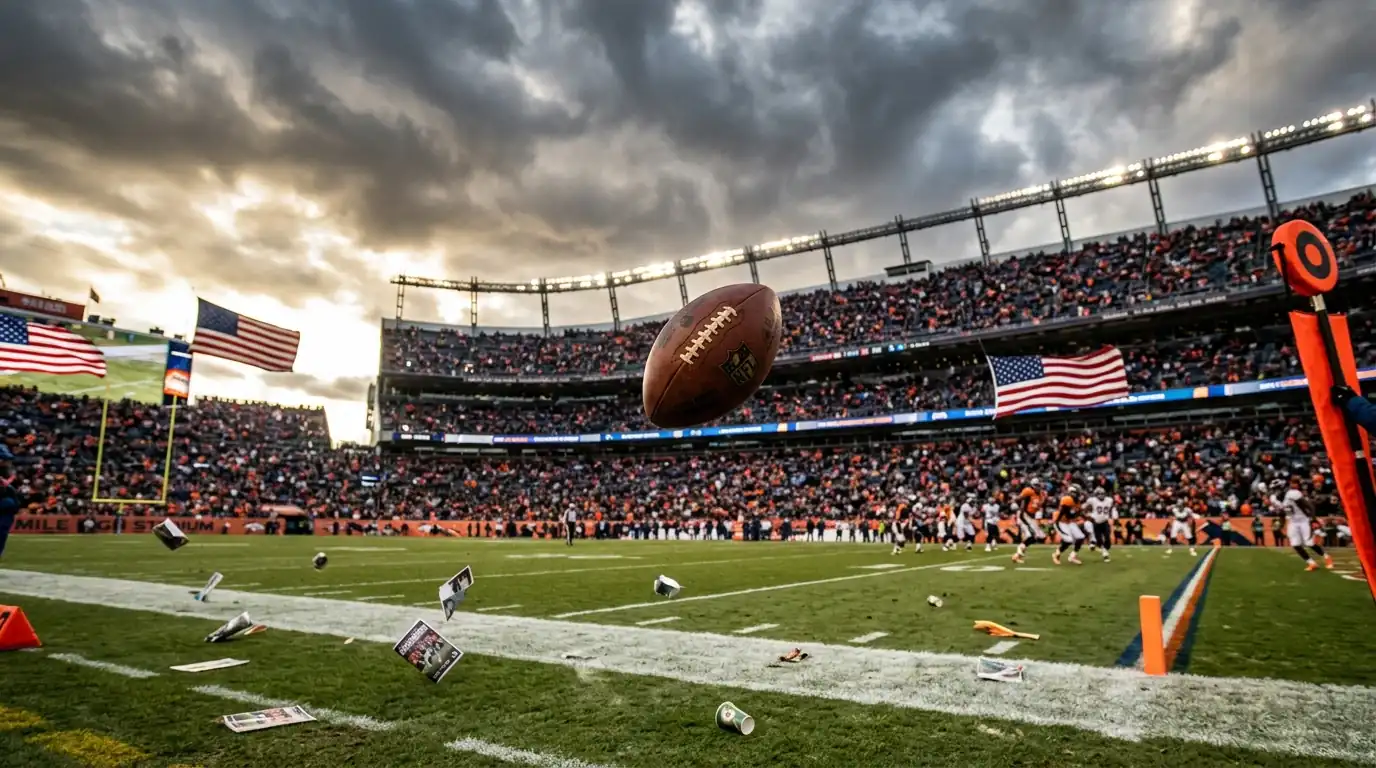
I lost a season-long profit on a single Sunday in November 2019. Three bets, all on passing-heavy offences, all in games where sustained winds topped 22 mph. The totals I backed were set as if those quarterbacks would operate in a vacuum. They did not. That weekend taught me what nine years of modelling have since confirmed: wind speed is the single most exploitable weather variable in NFL betting, and most bettors — including me, back then — treat it as background noise rather than a primary input.
The average NFL game is played in roughly 7 mph wind. That baseline matters because it means anything above it is already unusual, and the scoring impact does not scale linearly. A jump from 7 to 15 mph nudges completion rates down by a percentage point or two. A jump from 15 to 20 mph buckles passing production. And above 25 mph, you are watching a different sport entirely — one dominated by handoffs, punts, and missed field goals. Each of those thresholds deserves its own analysis, and that is exactly what this piece delivers.
Analyzing the Impact of Wind Speed on NFL Totals
Ask ten bettors what weather factor matters most for NFL, and you will get three answers: cold, rain, wind. Ask ten meteorologists who work with sportsbooks, and you will get one. Kevin Roth, chief meteorologist at RotoGrinders, put it bluntly: “Wind has the biggest impact on sports betting. You’ll see people betting unders on the total when winds are near or over 20 mph, because it makes throwing intermediate and deep passes difficult, as well as essentially eliminates longer field goals.”
Why wind and not temperature or precipitation? Because wind disrupts the two highest-leverage phases of the game simultaneously. First, the passing attack. A quarterback releasing the ball at roughly 55 mph into a 20 mph headwind loses effective velocity, meaning tighter windows, more inaccurate deep throws, and coordinators trimming the route tree back to slants and screens. Second, the kicking game. A field goal that comfortably clears the crossbar at 48 yards in calm conditions becomes a coin flip at that distance in a 20 mph crosswind. No other weather variable attacks two separate scoring mechanisms at once.
Rain reduces grip. Cold stiffens muscles. But both of those effects can be partially offset by gloves, heated sideline equipment, and modern synthetic footballs. Wind offers no equipment solution. You cannot glove your way through a 25 mph gust. The ball goes where the air pushes it, and the data reflects this. An analysis of more than 13,000 NFL matches going back to 1966 identified wind speed and temperature as the two statistically significant predictors of scoring output — but wind produced the larger coefficient, especially above certain thresholds.
Temperature also tends to co-travel with wind in late-season games, which muddies isolated analysis. Wind is cleaner to model. If a December game in Buffalo forecasts 8 degrees and 25 mph gusts, both matter, but the 25 mph gusts will do more to suppress the total than the 8-degree reading will. This is why I build my weekly models wind-first.
For UK bettors, there is an additional structural advantage. British sportsbooks import their NFL lines from US originators, often with a slight delay. Weather-driven line moves on totals typically originate in the US market, and the lag between Pinnacle’s adjustment and what appears on a UK-licensed platform can be anywhere from thirty minutes to several hours. If you know how to read a forecast and have identified the relevant threshold, you are effectively trading on information the UK line has not yet priced in. That edge is real, and it begins with understanding exactly where wind speed crosses from irrelevant to material.
The 15 mph Floor
Fifteen miles per hour is where I start paying attention — not where I start betting. Think of it as the tripwire: the moment the forecast crosses 15 mph sustained, I pull up the stadium orientation, check the gust forecast, and begin watching the line. Below 15 mph, wind is atmospheric decoration. Above it, the numbers shift.
CapperTek’s analysis of five NFL seasons found that completion percentage drops by approximately 1.6 percentage points once sustained winds exceed 15 mph. That might not sound dramatic on its own, but consider what 1.6 points means across a full game. If a quarterback’s baseline completion rate is 65%, a 1.6-point drop takes him to 63.4%. On 35 attempts, that is roughly one fewer completion. One fewer completion means one fewer chain-moving throw, which translates to one fewer scoring drive in a game where teams average about twelve possessions each. The marginal effect on the total is small — perhaps half a point — but it is real and it is consistent.
The practical question at 15 mph is not whether to slam the under. It is whether the posted total already accounts for the forecast. In my experience, totals at this level are rarely adjusted by more than a point, if at all. Sportsbooks treat 15 mph as noise. The market does not panic until 20. That gap between reality and market perception is where I have found the most repeatable edge at this threshold: not by betting aggressively, but by eliminating games from my card where I had planned to back the over. If a game forecasts 15-18 mph and I was leaning over, I scratch it. The expected value of the over shrinks just enough to make it a neutral proposition rather than a positive one, and neutral propositions do not deserve my bankroll.
There is a subtlety here that gets lost in threshold talk. Wind at 15 mph sustained with gusts to 22 mph is not the same as a steady 15 mph. Gusts create timing disruptions for quarterbacks that sustained wind does not. A steady 15 mph headwind is predictable; the quarterback adjusts his release point and carries on. A gust from 12 to 22 mph mid-throw creates the kind of wobble that turns a catchable ball into a batted-down prayer. When I see a forecast reading “15 mph sustained, gusts to 22+”, I model it closer to a 20 mph game than a 15 mph game. The distinction matters more than most published analyses acknowledge.
One more note for UK-based modellers: American weather services report sustained wind as a two-minute average and gusts as the peak three-second reading. The Met Office uses similar conventions but measures at 10-metre height by default. NOAA’s hourly forecasts for NFL stadium locations are your best primary source, and they update frequently enough that a check at 9 AM GMT on game day — roughly four hours before the early kickoffs — catches any meaningful shift from the Friday forecast.
The 20 mph Tipping Point
Twenty miles per hour is the number that moves markets. It is the threshold where sharp bettors begin hammering unders, where sportsbook traders start shading totals downward, and where the data stops being suggestive and becomes conclusive. I treat 20 mph as the line between a game where weather is a factor and a game where weather is the factor.
FOX Sports research, drawing on data from 2015 onwards, found that the under hits in 54% of NFL games with winds exceeding 20 mph. That number deserves context. In a market where the vig means you need to win roughly 52.4% of bets just to break even, 54% represents a genuine positive-expectation edge — slim, but real, and crucially, it is measured across a broad enough sample to be taken seriously. The under does not always win. But it wins often enough, and consistently enough, to warrant systematic attention.
What happens mechanically at 20 mph? Completion rates collapse. CapperTek’s five-season dataset shows the league-average completion rate dropping from its baseline of 60.3% all the way down to 54.65% in the 20-25 mph band. That is a fall of nearly six percentage points — the difference between a league-average passer and one who would rank dead last in the NFL. Every 5 mph of wind reduces completion percentage by 2-3 points, but the drop accelerates as you move up the scale. The relationship is not linear; it is convex. Going from 10 to 15 mph costs you two points. Going from 15 to 20 costs you three. And going from 20 to 25 costs you three or more, on a base that is already suppressed.
The practical impact extends beyond raw completions. At 20 mph, coordinators begin self-censoring. Deep routes — posts, corners, go routes — become low-percentage plays even for elite arms. The average depth of target shrinks, which compresses yards per completion, which in turn reduces scoring efficiency even when completions do occur. A team completing 55% of its passes on seven-yard routes is generating far fewer points per drive than one completing 62% on twelve-yard routes. The total feels the squeeze from both directions: fewer completions and shorter completions.
I have found that the 54% under rate at 20 mph is most exploitable early in the week. By Sunday morning, the sharp action has typically pushed the total down by 1.5 to 2.5 points from the opener. If you are waiting until kickoff to bet the under in a 20 mph game, you are almost certainly getting a worse number than the market movers did. My routine is to flag high-wind games on Wednesday — when the National Weather Service’s seven-day forecast first becomes reasonably reliable for Sunday — and place the bet if the total has not yet moved. By Thursday or Friday, the value is usually halved.
One caveat that I have learned the hard way: do not treat 20 mph as a magic line that makes every under a winner. A game between two run-heavy teams in 22 mph wind may already have a depressed total of 37.5. The under is not automatically the play just because wind exceeds 20 mph. The question is always whether the line has absorbed the information. If the total opened at 44 and has already dropped to 39, the market has done its job and the edge is gone. If the total opened at 44 and still sits at 43.5 on Thursday despite a 22 mph forecast, that is where I lean in.
The 25 mph Extreme
I keep a short list of games I call “ground-and-pound specials”. These are contests where the forecast reads 25 mph or higher sustained, and both teams effectively abandon the passing game before the opening whistle. The list is short because truly extreme wind games are rare — perhaps six to ten per season across the entire league — but when they happen, the betting landscape warps.
Above 25 mph, passing production drops by more than 10%. That figure alone is striking, but the downstream effects are where the real value hides. Running backs in these games gain an average of five additional fantasy points compared to calm conditions, reflecting a massive shift in play-calling philosophy. Teams that entered the week planning a 60/40 pass-run split suddenly find themselves running the ball on 55-60% of snaps. The game becomes a war of attrition: shorter drives, more punts, fewer big plays, and — critically for totals bettors — fewer points.
At this level, the kicking game functionally ceases for anything beyond 35 yards. A 45-yard field goal attempt in 25 mph crosswind is an act of optimism, not strategy, and most coaches know it. Fourth-down decisions shift dramatically: teams go for it more often inside the opponent’s 35-yard line because the field goal alternative has become unreliable. This creates an unusual dynamic where individual drives either end in touchdowns or turnovers on downs, with very little middle ground. The scoring variance per drive increases even as the total scoring output decreases.
For bettors, 25 mph games present a paradox. The under is the obvious play, and the market knows it. Totals in these games often drop three to four points from the opener by Sunday morning. The question becomes whether the market has overcorrected. In my experience, it sometimes does — particularly when the wind forecast downgrades from 28 mph on Friday to 22 mph by Sunday morning. Late forecast shifts can leave the total depressed below where the weather actually warrants, creating a rare over opportunity in what everyone assumed would be a defensive slog.
The discipline here is patience. If the forecast holds at 25+ through Saturday evening, the under is likely already priced. If the forecast softens, the over becomes the contrarian value play. I check the forecast three times in these situations: Wednesday for initial identification, Friday evening for confirmation, and Sunday morning for the final call. The Sunday morning check is non-negotiable because mesoscale weather shifts in the Great Lakes and Northeast corridor — where most extreme wind games occur — can flip a forecast in twelve hours.
Crosswind vs Headwind on the Throw
Not all 20 mph winds are created equal, and this is something the raw threshold data cannot tell you. A headwind at 20 mph works against every forward throw a quarterback makes, compressing his effective range by five to eight yards. A tailwind at 20 mph can actually help deep balls, adding carry and extending range. But a crosswind at 20 mph? That is the silent destroyer of accuracy, and it is the one that sportsbook totals underweight most consistently.
Ivetta Abramyan, a meteorologist and co-founder of Bettor Weather, described the mechanism precisely: “The wind will make passing difficult and can affect the game by forcing the teams to run the ball more, reducing the number of possessions, inaccuracies with kicking direction and loss of distance, and then slower reaction time by the defense.” Her point about kicking direction is especially relevant for crosswind analysis. A headwind shortens a kick but does not redirect it. A crosswind pushes the ball laterally, which is far harder for kickers to compensate for because their muscle memory is built around a vertical swing plane.
When I model wind for a specific game, I do not just plug in the sustained speed. I look at the stadium’s orientation relative to the prevailing wind direction and ask: is this headwind, tailwind, or cross? The answer changes the expected impact on both the passing game and the kicking game. A 20 mph headwind at Highmark Stadium in Buffalo, where the open end faces the prevailing westerlies, hits quarterbacks throwing toward that end zone with full force. A 20 mph crosswind at MetLife in New Jersey, where the stadium sits broadside to the typical wind flow, creates lateral drift on every deep throw regardless of direction.
The distinction matters for prop markets too. If the wind is primarily a headwind-tailwind dynamic, the impact on passing volume is directional — one team faces it while the other benefits. Quarterback props for the team throwing into the wind deserve a steeper discount than for the team throwing with it. If the wind is a crosswind, both quarterbacks suffer equally, and the total is the cleaner bet. The principle is simple: direction matters as much as speed, and stadium geometry determines the direction.
Wind and Field Goal Decision Making
Here is a coaching decision that most bettors overlook entirely: the choice to attempt a field goal or go for it on fourth down is itself weather-dependent, and that decision ripples through the total in ways the raw scoring data does not capture.
In calm conditions, an NFL kicker converts roughly 83% of his field goals across all distances. That rate is high enough that coaches almost always send the kicking unit out for anything inside 50 yards. But wind changes the calculus. Snow conditions alone drop that league-wide conversion rate to 76% — a seven-percentage-point decline — and wind amplifies the effect further, especially beyond 40 yards. When sustained winds exceed 20 mph, the effective range of a field goal attempt shrinks by ten yards or more. A 47-yard attempt that a coach would green-light in still air becomes a coin flip in heavy wind, and coaches increasingly know this.
The result is a shift in fourth-down behaviour. In high-wind games, teams attempt fewer field goals and go for it on fourth down more often in opponent territory. This creates a binary outcome pattern: drives that would normally end in three points instead end in either seven points — if the fourth-down conversion succeeds and leads to a touchdown — or zero points, if it fails. The expected points per drive become more volatile even as the mean decreases.
What does this mean for totals? In most cases, it reinforces the under, because the zero-point outcomes outnumber the seven-point conversions. Fourth-down conversion rates in the NFL sit around 50%, which means half of the drives that would have produced three points via field goal now produce nothing. The net effect is a reduction of roughly 1.5 expected points per game from the kicking game alone, on top of whatever suppression the wind creates in the passing game.
Wind speed affects kicker accuracy dramatically across distance buckets, and the crosswind penalty is the component most analyses ignore. The short version: if the forecast says 20 mph and the game features two mid-tier kickers, subtract a full field goal from each side in your mental model. That is six points off the total before you even consider the passing game.
Wind-Adjusted Totals: Worked Examples
Theory is useful. Practice is better. Let me walk through two real-world scenarios to show how I apply wind thresholds to an actual betting decision.
Scenario 1: A Late-November Bills Home Game
It is Wednesday morning, and the NWS seven-day forecast for Orchard Park, New York shows sustained winds of 23 mph with gusts to 35 mph for Sunday at 1 PM ET. The total on the early-week line is 44.5. Here is my process. I note that 23 mph sustained puts this firmly in the 20-25 mph band, where completion rates drop from a baseline of 60.3% to approximately 54.65%. I adjust for gusts: 35 mph peaks suggest this game will spend portions of each half in the 25+ mph extreme zone. The passing game for both teams will be severely compromised. I expect rushing attempt percentages to climb above 50% for both sides, and field goal attempts beyond 40 yards to be functionally eliminated.
My internal fair-value total for this game, before considering teams, is approximately 38-39 points. The line is 44.5. That is a five-to-six-point gap, which is enormous. But I check the line trajectory: has the total already moved from an opener of 47? If so, the sharp market has begun pricing the wind, and my edge is narrowing. In this scenario, let us say the total has ticked down to 43 by Wednesday afternoon. That still leaves me four points of perceived value. I place the under at 43, knowing that by Friday the line will likely sit near 40-41 once the broader market absorbs the forecast. My bet is locked in at a better number.
Scenario 2: A Week 4 Game at Soldier Field
Early October, and the forecast shows 16 mph sustained with gusts to 24 mph. The total is 42. This is a borderline case — right at the 15 mph floor, with gusts flirting with the 20 mph zone. My approach here is different. I do not bet the under. Instead, I remove the game from my “over” consideration list. The expected suppression at 16 mph sustained is roughly one point on the total, which is not enough to make the under a positive-expectation bet at 42. But it is enough to make the over a worse bet than it looked on paper when I circled the game earlier in the week. The discipline is in what I choose not to bet, as much as what I do.
These two scenarios illustrate the core principle: wind thresholds are not on-off switches. They are gradient markers on a curve, and the right response depends on where the forecast falls, how far the line has already moved, and how much time remains before kickoff for further adjustment. The 15 mph floor tells me to watch. The 20 mph tipping point tells me to act. The 25 mph extreme tells me to act early or accept that the value has evaporated.
Frequently Asked Questions
At what wind speed does an NFL passing offence start to break down?
The measurable decline begins at 15 mph sustained, where completion percentage drops by roughly 1.6 percentage points. The breakdown accelerates at 20 mph, with completion rates falling from a league average of 60.3% to approximately 54.65%. Above 25 mph, passing production drops by more than 10% and the game fundamentally shifts to a ground-based contest.
Does crosswind affect kickers more than headwind in NFL games?
Yes. A headwind reduces distance but keeps the ball on a predictable vertical path. A crosswind pushes the ball laterally, which is far harder for kickers to compensate for because their swing mechanics are built around a vertical plane. In my modelling, a 20 mph crosswind degrades kicker accuracy more than a 20 mph headwind at equivalent distances, particularly beyond 40 yards.
How do indoor stadium teams cope with sudden wind exposure outdoors?
They generally do not cope well. Dome-based offences practise and scheme in still air all week, and their quarterbacks calibrate release points to zero-wind conditions. When these teams travel to outdoor cold-weather venues with significant wind, the adjustment is immediate and the data shows suppressed passing efficiency. The NFL’s retractable roof rule — where the roof stays open if conditions are above 40 degrees Fahrenheit and winds are below 40 mph — adds a layer of uncertainty that can create late line movement.
Created by the ”Weather Impact on nfl Betting” editorial team.