Light Rain vs Heavy Rain NFL Betting: The Two-Point and Six-Point Lines
 Available in US
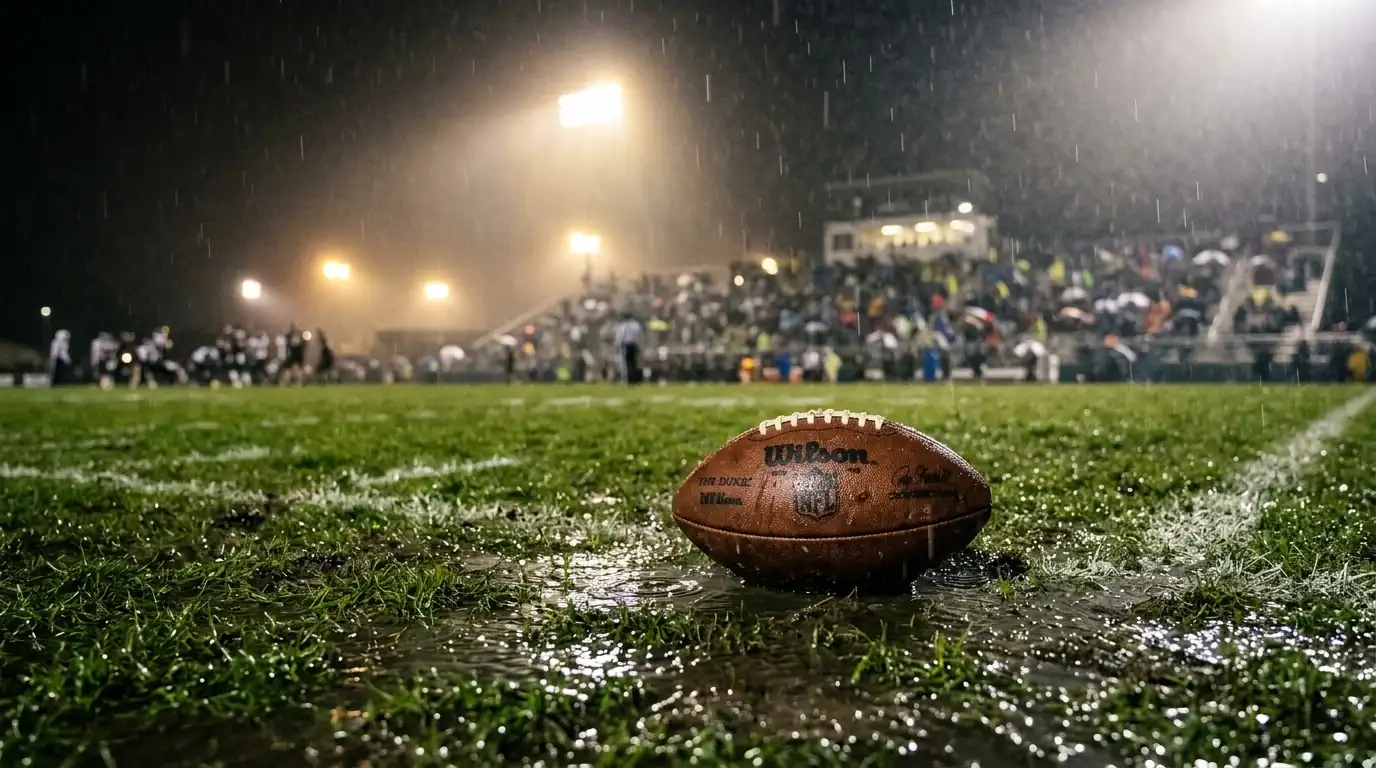
Rain is the most misunderstood weather variable in NFL betting. I have watched bettors hammer the under the moment a forecast shows a cloud icon with raindrops, treating drizzle and downpour as if they were the same phenomenon. They are not. The data is specific: light rain reduces NFL scoring by roughly 2 points. Heavy rain reduces it by roughly 6. That fourfold difference is the gap between a mild adjustment and a genuine market-moving event, and confusing the two costs money.
Sharp Football Analysis data breaks precipitation into graduated severity bands, each with its own scoring impact. Light rain or snow costs about 2 points off the combined total. Moderate rain costs about 4. Moderate snow costs 6. Heavy rain costs 6. Heavy snow costs 10. These numbers are averages across decades of NFL games, and they provide a framework that most recreational bettors — and some sportsbooks — apply too bluntly.
The 2-Point Light Rain Adjustment
Light rain — typically less than 0.1 inches per hour, the kind of steady drizzle that makes the ball slightly slippery but does not fundamentally alter play calling — produces a scoring reduction of approximately 2 points. That is the difference between a 44-point combined score and a 42-point combined score. In practical terms, it is almost invisible on any single game but detectable across a large sample.
Why only 2 points? Because light rain affects the ball’s surface more than it affects the playing field or the players’ biomechanics. Receivers report that the ball feels marginally harder to grip, and quarterbacks occasionally adjust their release point to compensate. But footing remains solid, visibility is unaffected, and coaches do not significantly alter their game plans for drizzle. The passing game operates at roughly 95 percent of its normal efficiency.
For bettors, a 2-point adjustment is rarely worth acting on by itself. If a total is posted at 45.5 and light rain is forecast, my adjusted total is 43.5 — the under has a marginal lean, but not enough to justify a bet unless other factors (wind, cold, defensive matchup) compound the effect. I treat light rain as a tiebreaker: if I am already leaning under for non-weather reasons, a light rain forecast confirms the lean. If I have no other view, I pass.
The exception is prop betting. A 2-point reduction in total scoring maps onto roughly 12 to 18 fewer combined passing yards, which can tip a quarterback’s passing yards prop line from a marginal over to a marginal under. In a market where passing yards props are set to the half-yard, even a small weather adjustment can create value.
The 6-Point Heavy Rain Adjustment
Heavy rain — sustained rates above 0.3 inches per hour, often accompanied by wind and reduced visibility — changes the character of an NFL game entirely. The 6-point scoring reduction reported by Sharp Football Analysis and supported by MyRadar/CBS data means that a game expected to produce 46 combined points in clear weather will, on average, produce 40 in heavy rain. That is not a subtle effect. It is the difference between a closely contested over-under and a comfortable under winner.
Heavy rain attacks scoring through multiple channels simultaneously. Passing efficiency drops sharply: teams average roughly 45 fewer passing yards in rainy conditions, according to CapperTek’s analysis. Ball security deteriorates, with drop rates climbing to around 6 percent compared to roughly 3 percent in dry conditions. And field goal attempts become less reliable, particularly at longer distances where wet footing compromises the kicker’s plant step.
The point spread is also affected, though less dramatically. Heavy rain reduces the point spread by approximately 1.5 points because it compresses the performance gap between teams — the better team’s passing attack, which is typically its primary advantage, is degraded more severely than the weaker team’s simpler offensive scheme. Underdogs perform slightly better than expected in heavy rain, which is consistent with the general principle that adverse conditions equalise talent differences.
For my own betting, heavy rain is one of the clearest weather signals available. If the forecast shows sustained heavy rainfall throughout the game (not just a first-quarter shower), I apply the full 6-point discount and compare it against the posted total. If the total has not moved down by at least 4 points from the clear-weather opener, there is likely value on the under.
The 45-Yard Passing Loss Explained
CapperTek’s finding that teams average 45 fewer passing yards in rainy conditions deserves closer examination, because it is a larger effect than most bettors expect. On a dry day, an average NFL team produces roughly 230 to 250 passing yards. A 45-yard reduction brings that down to 185 to 205 — a decline of approximately 18 to 20 percent.
Where do those 45 yards go? About half of the decline comes from reduced completion percentage — quarterbacks complete roughly 3 to 4 fewer passes per game in rain, each of which would have averaged 6 to 8 yards. The other half comes from shortened route depth. Coaches call fewer 15-plus-yard routes in rain because the combination of a slippery ball and uncertain receiver footing makes those throws high-risk. The passing game contracts to short and intermediate zones, where completions are more reliable but yardage per reception drops.
This 45-yard figure is an average that encompasses both light and heavy rain. In heavy rain specifically, the reduction can exceed 60 yards. In light drizzle, it may be only 15 to 20. The severity distinction I outlined above applies directly: if the forecast calls for light rain, discount the passing yardage by roughly 15 to 20 yards; if it calls for heavy rain, discount by 50 to 60. Those numbers map directly onto receiver and quarterback prop lines.
Forecast Language: mm/hr and What It Means
One problem UK bettors face is translating American weather forecasts into actionable severity categories. The Met Office and NOAA use slightly different terminology, and neither maps perfectly onto the “light/moderate/heavy” bands that the betting data relies on.
For practical purposes, I use rainfall rate in millimetres per hour as the universal translator. Light rain corresponds to less than 2.5 mm/hr (0.1 inches/hr). Moderate rain is 2.5 to 7.5 mm/hr (0.1 to 0.3 inches/hr). Heavy rain exceeds 7.5 mm/hr (0.3 inches/hr). NOAA’s hourly forecasts provide quantitative precipitation forecasts that allow you to estimate where a game’s rainfall will fall on this scale.
The complication is temporal coverage. A forecast showing 8 mm/hr for the first hour but 1 mm/hr for the remaining three hours is a different proposition from 4 mm/hr sustained throughout the game. My approach is to weight the kickoff-hour forecast most heavily (since that is when the total is priced) and then adjust if the remainder of the forecast diverges significantly. A game that starts in a downpour but clears by halftime will not behave like a full-game heavy rain event — but it may not behave like a dry game either, because the first half’s scoring suppression creates a deficit that alters second-half game scripts.
The Severity Line That Separates Noise from Signal
Light rain is noise. Moderate rain is a lean. Heavy rain is a signal. That three-tier framework has been the most profitable simplification in my weather-betting process. The 2-point light rain adjustment rarely survives the bookmaker’s margin. The 6-point heavy rain adjustment regularly does. The discipline is in resisting the temptation to treat all precipitation as heavy and instead doing the two-minute check — is the forecast calling for 1 mm/hr or 10 mm/hr? — that separates a costly overreaction from a well-calibrated bet. Get the severity right, and the downstream adjustments on drops, fumbles, and rushing volume all fall into place.
What rainfall rate counts as heavy for NFL totals?
Above 7.5 mm per hour (0.3 inches per hour) is the threshold where scoring reductions become substantial — roughly 6 points off the combined total. Below 2.5 mm per hour qualifies as light rain, producing only a 2-point adjustment that rarely justifies a standalone bet.
Does forecast confidence change the adjustment size?
Yes. A forecast showing 90 percent probability of heavy rain throughout the game warrants the full 6-point adjustment. A 40 percent probability should be discounted proportionally — I typically apply roughly half the adjustment, because the expected weather is a blend of rain and dry conditions. Check the hourly breakdown rather than the headline probability.
Prepared by the Weather Impact on nfl Betting editorial staff.