NFL Snow and Rain Betting Strategies for UK Bookmakers
 Available in US
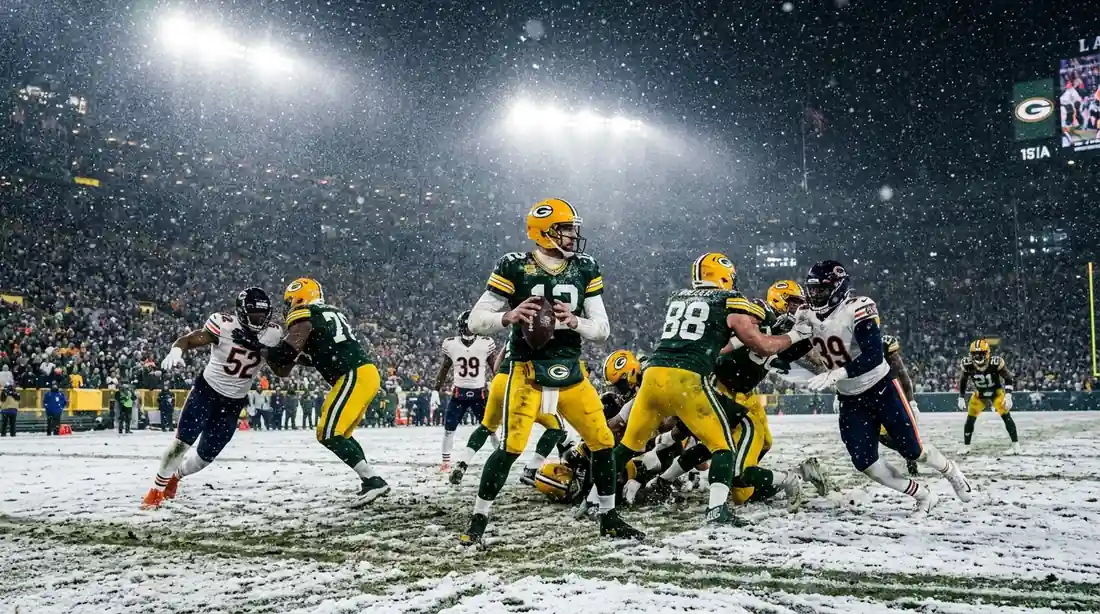
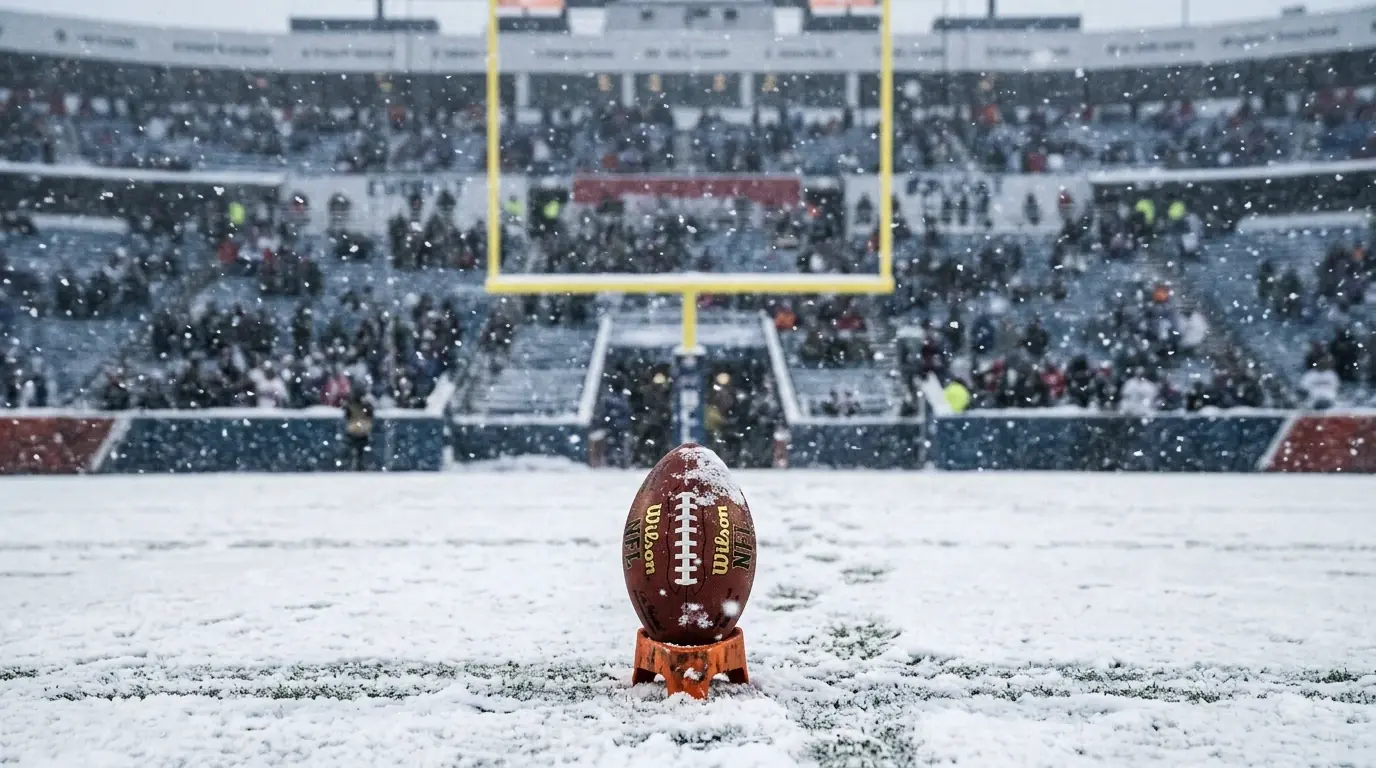
December 2022, and I am watching a Saturday night game dissolve into a snowglobe. Heavy snow is piling up in Buffalo, and the total — which opened at 46 — has already cratered to 37.5. I had the under at 43 from Wednesday. The game finishes 32-29. Over. Sixty-one points in a blizzard. That result broke every lazy assumption I had about precipitation and scoring, and it forced me to rebuild my precipitation model from scratch.
The lesson was uncomfortable but clarifying: not all precipitation is the same, and treating “bad weather” as a single category is the fastest way to lose money on NFL totals. Heavy snow suppresses scoring by 25% on average. Light snow barely moves the needle — roughly a 2% reduction. Rain is even more nuanced, because the real culprit behind rain-game scoring drops is usually the wind that accompanies the rain, not the water itself. The distinction between light and heavy, between rain and snow, between wet conditions with wind and wet conditions without it — these are the margins where informed UK bettors can find value that the recreational market consistently misprices.
Light and Heavy Precipitation Distinctions in NFL Betting
The scoring impact of precipitation follows a severity scale that most betting content ignores entirely. I spent two seasons tracking this manually before I found a published framework that matched my data, and the numbers are worth memorising because they form the backbone of every precipitation adjustment I make.
Light rain or light snow knocks roughly two points off the total. That is it. Two points. In a game with a posted total of 45, the weather-adjusted fair value is about 43. Unless the total is sitting right on that margin, light precipitation alone is not enough to generate a betting edge. Moderate rain pushes the adjustment to four points. Moderate snow pushes it to six. These are significant — a six-point adjustment on a total of 45 means a fair value near 39, which is a world away from the posted number. Heavy rain takes the adjustment to six points as well, while heavy snow — the true outlier — suppresses scoring by roughly ten points on average.
The problem for bettors is that weather forecasts do not always distinguish cleanly between “light” and “heavy”. A forecast reading “snow expected, 1-3 inches” is light. A forecast reading “heavy snow, 6-10 inches, blowing and drifting” is a different animal entirely. I have trained myself to look for specific language: “heavy”, “blowing”, “whiteout conditions”, “accumulating rapidly” — these signal the severe end of the scale. “Scattered showers”, “light snow showers”, “flurries” — these are cosmetic. They change the visual texture of the broadcast but barely touch the scoreline.
The ten-point suppression in heavy snow is the outlier that defines the category. That is the 25% scoring reduction I referenced earlier, applied to a typical total of 44. But heavy snow games are rare — perhaps four to six per season across the entire league — and sportsbooks know they are coming. By kickoff, the total in a genuine blizzard game has usually dropped by six to eight points from the opener. The residual edge for an under bet is smaller than the raw ten-point adjustment suggests, because the market has already absorbed most of it. Where the edge persists is in the light-to-moderate zone, where the two-to-six-point adjustments are small enough that sportsbooks often leave the total unchanged or move it by only a single point.
My rule of thumb: if the adjustment exceeds the line movement, bet the under. If the line has moved as much as or more than the expected adjustment, the value is gone. This sounds simple, and it is, but it requires discipline to walk away from a snow game where every instinct screams “under” but the line has already done its job.
To fully grasp how precipitation affects scoring, you should review historic NFL snow game over under data before finalizing your ticket.
Snow and the 25 Percent Rule
Twenty-five percent. That is the average scoring reduction in NFL games played in heavy snowfall, and it is the single most reliable weather-to-scoring relationship in the entire sport. Not wind. Not cold. Heavy snow. The reason is mechanical: snow affects every phase of the game simultaneously. Passing routes lose traction. Receivers cannot plant and cut. The ball becomes slippery and hard to grip. Field goal kicking drops from an 83% league-wide conversion rate to 76% — a seven-percentage-point decline that effectively removes three-point opportunities from the game. And the field itself becomes a variable, with footing deteriorating as the game progresses and accumulation builds.
What makes the 25% rule useful rather than merely interesting is its consistency. Light snow — flurries, a dusting, the kind that looks dramatic on camera but melts on contact with the field surface — reduces scoring by only 2%. The gap between 2% and 25% is enormous, and it maps directly to accumulation rate. If snow is accumulating on the field faster than the grounds crew can clear it between possessions, you are in heavy-snow territory. If the field surface remains mostly visible throughout the game, you are in light-snow territory. There is no precise inch-per-hour threshold published in the literature, but my working rule is this: if the forecast calls for three or more inches during the three-hour game window, model it as heavy.
The kicking game deserves special emphasis here. That 76% conversion rate in snow represents a broad average, but the distance breakdown is even more telling. Short field goals — under 30 yards — remain fairly reliable even in snow, because the ball’s flight time is brief and the margin for error is wide. Beyond 40 yards, snow-game conversion rates drop below 65%. Beyond 45 yards in heavy snow, coaches increasingly opt to punt or go for it on fourth down rather than attempt what has become a low-probability kick. This decision shift compounds the scoring suppression: fewer field goal attempts mean fewer points from the kicking game, which feeds into the total depression.
The kicking angle deserves its own emphasis. Field goal accuracy in snow conditions drops dramatically when broken down by distance bucket. In a heavy snow forecast, mentally subtract two field goals from the total — six points — on top of whatever you subtract for passing suppression. The two effects stack, which is why the overall 25% reduction is so large.
I track every heavy-snow game each season in a simple spreadsheet: date, teams, posted total, closing total, final score, over/under result. Across the last five seasons, the closing total in heavy-snow games has undershot the final score about 35% of the time, meaning the market overcorrects roughly one game in three. That is not frequent enough to make the over a systematic play, but it is frequent enough to make me cautious about blindly slamming the under when the total has already dropped five or six points from the opener. The 25% rule tells me what fair value is. The line movement tells me whether the market has already found it.
Rain and the Hidden Wind Overlap
Rain is the most overrated weather variable in NFL betting. I say that knowing it will sound contrarian, but the data supports it: rain alone — without significant wind — suppresses passing production by roughly 12%, and the majority of that suppression is actually explained by the wind that tends to accompany rainstorms, not by the rain itself.
Think about what rain does to an NFL game. The ball gets wet, which reduces grip for the quarterback and makes catching harder for receivers. Teams in rainy conditions average about 45 fewer passing yards per game. But modern NFL footballs are synthetic-panelled and treated with grip-enhancing compounds. Quarterbacks wear gloves designed to maintain friction in wet conditions. Receivers use towels between plays. The technological adaptation to rain has been substantial over the past two decades, and the scoring impact has diminished accordingly.
What has not diminished is the impact of the wind that typically arrives with rain. Rainstorms are driven by low-pressure systems, and low-pressure systems generate wind. A game that forecasts “moderate rain” almost always features sustained winds of 12-18 mph, which puts it near or above the 15 mph threshold where passing efficiency starts to decline. When researchers isolate rain from wind — looking at games with rain but winds below 10 mph, which do occur in slow-moving frontal systems — the scoring suppression drops to roughly 3-4%, barely more than a rounding error on a 44-point total.
This overlap matters enormously for bettors because the recreational market overreacts to rain. The word “rain” in a forecast triggers an emotional response in casual bettors. They envision muddy fields, dropped passes, and defensive slugfests. They pile onto the under. But the sharp market knows that light-to-moderate rain without wind is essentially a non-event for scoring purposes. The result is that totals in rainy games sometimes drop further than the weather warrants, creating value on the over for those who understand the mechanism.
My approach to rain games is to strip the forecast down to its components. I ask three questions. First, what is the sustained wind speed? If it is below 15 mph, rain alone will not suppress scoring enough to move my model. Second, what is the expected rainfall intensity? Light rain (drizzle, intermittent showers) barely matters; heavy rain (steady downpour, thunderstorm) begins to affect ball security in ways that go beyond passing. Third, is the rain expected throughout the game or confined to one half? A forecast that calls for showers in the first quarter followed by clearing skies is not the same as four hours of steady rain. I care about the conditions during the third and fourth quarters most, because that is when close games are decided and scoring variance is highest.
There is a UK-specific angle here that rarely gets discussed. British bettors checking the forecast for a 1 PM Eastern kickoff are doing so at 6 PM GMT — after the working day, often on a phone, often glancing at a headline forecast rather than drilling into hourly windspeed data. The headline will say “Rain expected in Green Bay” and the bettor will think “under”. The hourly data might show light rain with 8 mph wind through the first half and clearing skies in the second. Those are not the same forecast, but they produce the same headline. I use NOAA’s hourly breakdowns for US games, and for the London fixtures I cross-reference the Met Office’s site-specific data. The extra ten minutes of digging separates a weather-informed bet from a weather-triggered guess.
Drops, Fumbles, and Ball Security
Wet footballs are slippery footballs, and slippery footballs get dropped. The drop rate in rain or snow conditions climbs to approximately 6%, which is a meaningful jump from the dry-weather baseline of around 3.5%. That is not a subtle shift — it is nearly a doubling of the rate at which catchable passes hit the turf.
The knock-on effects are worth tracing. Every additional drop kills a potential completion, which kills a potential first down, which either stalls a drive or forces a punt. Over the course of a game, the extra drops translate to roughly two to three additional drive-ending incompletions per team. Multiply by two teams and you are looking at four to six fewer scoring opportunities per game. That maps neatly onto the four-to-six-point scoring suppression that moderate-to-heavy precipitation produces.
Quarterback fantasy production tells a similar story. In light-to-moderate rain, QB fantasy output drops by about 2.1 points per game. That figure includes the reduced passing yards, the additional incompletions from drops, and the interceptions that occasionally result from wet-ball wobbles. For UK bettors playing quarterback passing-yards props, that 2.1-point fantasy reduction translates to roughly 20-25 fewer passing yards — enough to swing an over/under on a passing-yards prop set at 250.
Ball security on the ground is a separate question, and the data is less dramatic than popular belief suggests. The idea that running backs fumble more in the rain is intuitively appealing but statistically weak. Ball carriers tuck the football against their body, and the contact point remains relatively dry under the arm. Fumble rates in wet weather tick up only marginally. The real ball-security risk is on exchanges — handoffs, snap-to-quarterback transfers, and pitches — where the ball is briefly exposed. The 6% overall drop rate in wet conditions is driven almost entirely by receivers, not ball carriers, which makes receiving yards unders the sharper play in rain games.
The Running Game as the Counterweight
Every point of passing production that bad weather strips away gets partially recycled into the ground game. This is not a theoretical claim — it is an observable shift in play-calling that shows up in every precipitation game. When the passing game becomes unreliable, coordinators lean on the run, and the running back becomes the centrepiece of the offence.
The shift is mechanical. In dry conditions, the average NFL team runs the ball on about 42% of plays. In heavy precipitation, that number climbs toward 55%. The additional rushing attempts do not always translate to additional rushing yards per carry — the field surface is compromised, footing is uncertain, and defensive fronts load the box knowing the pass threat is diminished. But volume compensates. A running back who gets 15 carries in a dry game might get 22 in a snow game, and even if his yards-per-carry drops from 4.5 to 3.8, his total output rises.
Ed Salmons, VP of risk management at Westgate SuperBook, noted that games in historically bad-weather cities like Cleveland, Buffalo, Pittsburgh, and Foxborough always have their totals set a little lower after Thanksgiving “just in case the weather is crappy”. That seasonal adjustment is a blunt instrument, though. It captures the average expectation but does not distinguish between a 35-degree rainy game and a full blizzard. The running game counterweight means that scoring does not collapse as far as the passing suppression alone would suggest, because the extra rushing attempts produce enough first downs to keep drives alive.
For bettors, the running game counterweight creates a specific opportunity in player prop markets. Lead-back rushing yards overs become more attractive in precipitation games, while receiving yards overs for wide receivers become less attractive. The market adjusts receiver props faster than running back props in my experience, because the connection between rain and passing is obvious while the connection between rain and rushing volume is one step removed. That lag is where the value sits.
There is a ceiling to this effect, though. If precipitation is severe enough — a genuine blizzard with accumulating snow and 25 mph winds — the running game is compromised too. Backs cannot cut effectively on a snow-covered field, and fumble risk on handoff exchanges rises. In those extreme cases, both sides of the ball are suppressed, and the total should reflect a universal decline rather than a simple shift from pass to run. The counterweight works best in moderate conditions: steady rain, light-to-moderate snow, or any precipitation game where the field surface remains playable but the passing game is hampered. In those situations, the ground game absorbs enough of the offensive workload to keep scoring above what a naive under model would predict.
Maximize your edge this winter with expert NFL weather analysis right from our homepage.
Why the Public Tail Matters Here
Recreational bettors overreact to rain. This is not speculation — it is a pattern I have tracked across six seasons of line movement data, and it aligns with what sportsbook insiders describe publicly.
The mechanism is straightforward. A casual bettor sees “rain” in the forecast, visualises a defensive struggle, and bets the under. Multiply that reaction across thousands of accounts, and the total moves down by a point or more beyond what the weather actually warrants. In light-to-moderate rain games, where the scoring adjustment should be two to four points at most, the total sometimes drops by five or six because the public is piling on.
Ed Salmons described how sharp bettors exploit this: they watch for weather fronts heading through on Sunday, and they begin acting six days before kickoff — well before the recreational market even checks the forecast. By the time the public notices the rain and hammers the under on Sunday morning, the line has already moved past fair value, and the sharp money has reversed to the over. The public becomes the tail wagged by the dog.
For UK bettors on platforms where line movement is visible, this creates a readable pattern. If a total drops steadily from Wednesday to Saturday on no news other than a rain forecast, and then drops again sharply on Sunday morning when the casual market arrives, the Sunday-morning drop is almost certainly recreational overreaction. That is not a guarantee the over will win, but it is a signal that the under is no longer the value side. Recognising when to step away from the under is just as important as knowing when to bet it.
Frequently Asked Questions
Does light snow really reduce NFL scoring or is it a myth?
Light snow reduces scoring by roughly 2%, which on a typical total of 44 translates to less than one point. It is not a myth, but it is negligible for betting purposes. The visual drama of snowflakes on camera far exceeds the statistical impact. Heavy snow is the real mover, suppressing scoring by approximately 25%.
Why does the passing game survive moderate rain better than expected?
Modern NFL footballs, quarterback gloves, and receiver towels have reduced the grip penalty of rain significantly. The larger factor in rainy-game scoring drops is the wind that accompanies most rainstorms, not the precipitation itself. When you isolate rain from wind — games with rain but sustained winds below 10 mph — the scoring impact shrinks to 3-4%, barely material for totals betting.
Are running-back props a reliable wet-weather play?
Lead-back rushing yards overs become more attractive in precipitation because play-calling shifts toward the run. A back who normally sees 15 carries may get 22 in a heavy-weather game. However, yards per carry often declines due to poor footing and loaded defensive boxes, so the edge is in volume-based props like rushing attempts rather than pure yardage. Committee backfields dilute the effect and are harder to project.
Written by the editors at Weather Impact on nfl Betting.