NFL Weather Line Movement and Odds Adjustments on UK Sportsbooks
 Available in US
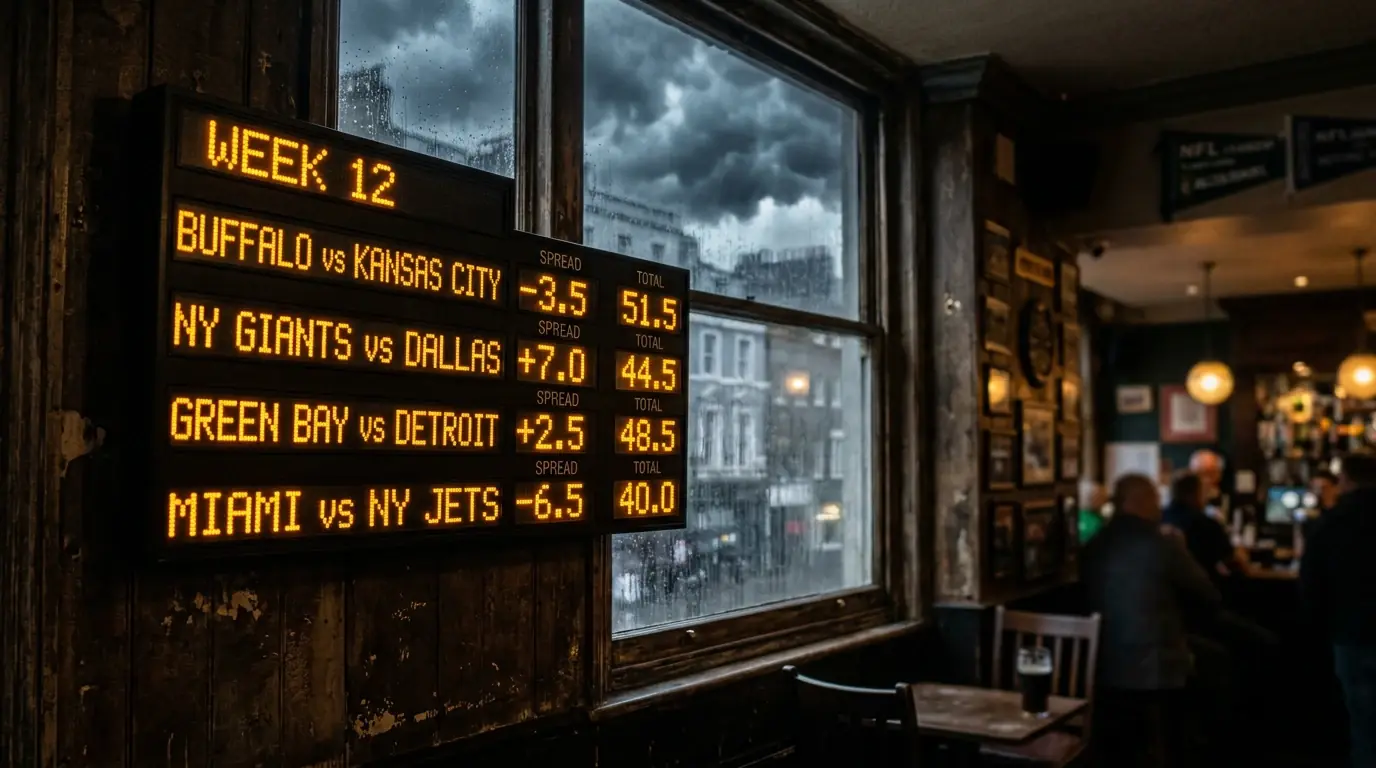
I spent three years tracking line movement across six UK-licensed sportsbooks before I understood the pattern. Every Thursday during NFL season, like clockwork, totals on outdoor games would begin drifting. Not all of them — just the ones where the seven-day forecast showed wind or precipitation in the host city. By Friday afternoon, the movement accelerated. By Saturday night, the lines had settled into their final positions, and by that point, the weather information was fully baked into the price. The bettors who profited were the ones who acted on Wednesday. The ones who waited until Sunday were buying stale goods.
UK sportsbooks do not originate NFL lines. They import them, adjust them, and present them to a market that behaves differently from the American one. Understanding how that import process works, where the delays sit, and how British weather expertise creates friction with American line-making is the foundation for exploiting weather-driven line movement from this side of the Atlantic.
UK Bookmaker Strategies for Importing US NFL Betting Lines
An American sharp once told me that betting NFL in the UK is like trading foreign equities on a delayed feed. He was not entirely wrong. The origination chain for NFL lines begins in the US — primarily at Pinnacle and the major Nevada sportsbooks — and propagates outward through a network of wholesale line feeds that supply operators globally. UK sportsbooks subscribe to these feeds and use them as their opening numbers.
The process is not instantaneous. A line move at Pinnacle might take anywhere from fifteen minutes to several hours to appear on a UK platform, depending on the operator’s infrastructure and how aggressively their trading desk monitors real-time feeds. The largest UK books — the ones with dedicated American sports trading teams — tend to update within thirty to sixty minutes. Smaller operators, or those that rely on third-party risk management, can lag by two to four hours or more.
This lag is structural, not accidental. UK operators face regulatory requirements under the Gambling Commission that American offshore books do not, including affordability checks and responsible gambling triggers that can slow the pipeline. More importantly, NFL is a secondary product for most UK sportsbooks. Football, horse racing, and tennis drive the majority of handle. The NFL trading desk at a mid-tier UK operator might consist of two people who also cover the NBA, NHL, and college football. They are not refreshing Pinnacle’s board every five minutes. They are updating lines in batches, often twice daily — once in the morning and once in the early afternoon GMT.
For weather-driven line movement, this batch-update model creates windows of opportunity. A weather forecast that shifts significantly at noon GMT — six hours before the early Sunday kickoffs — might not be reflected in a mid-tier UK sportsbook’s totals until their afternoon batch update at 2:00 or 3:00 PM. If you have already identified the weather shift and its likely impact on the total, you have a two-to-three-hour window to bet at numbers that are behind the curve. The edge is not large in absolute terms — typically half a point to 1.5 points — but it is systematic, meaning it recurs every week during the season.
The one exception to the lag pattern is live or in-play markets, where UK books use algorithmic pricing that updates in near real-time based on the score and game state. Weather is not well integrated into these algorithms, which creates its own set of opportunities. More on that below.
Before placing your wager based on line movement, make sure you understand the key NFL wind speed betting thresholds that actually impact passing games.
The Six-Day Lead Time Pattern
When does weather information first become tradeable? Not on Sunday morning. Not on Saturday. On Wednesday. The National Weather Service’s seven-day forecast, updated twice daily, first includes the following Sunday’s conditions by Wednesday morning US Eastern time. That forecast is not precise — it is a probability cone, not a point estimate — but it is reliable enough at the extremes to generate actionable signals. A Wednesday forecast showing 25+ mph winds in Chicago for Sunday does not guarantee those winds will materialise, but it puts the probability high enough that the sharp market begins positioning.
I have tracked this pattern across four full NFL seasons. The typical timeline for weather-driven line movement runs in three phases. Phase one, Wednesday through Thursday: sharp US bettors who monitor meteorological data — Kevin Roth’s forecasts, National Weather Service updates, proprietary models — identify games with high-probability adverse weather and begin betting. The total starts to move. Phase two, Friday through Saturday: the broader market notices the move, sports media mentions the weather angle, and recreational bettors pile on. The total continues to drop. Phase three, Sunday morning: the final forecast confirms or denies the weather threat, and the line makes its last adjustment.
For UK bettors, the timing creates a geographical disadvantage and a temporal opportunity. The geographical disadvantage is that Wednesday morning in the US is Wednesday afternoon in the UK, and by the time you check the forecast after work, phase one may already be underway. The temporal opportunity is that UK sportsbooks — particularly the smaller ones — often do not begin adjusting their NFL totals until Thursday or Friday, because their batch-update schedule does not prioritise midweek weather shifts. If the sharp US money has moved Pinnacle’s total by a point on Wednesday and your UK book still shows the old number on Thursday morning, you can place that bet at pre-movement odds.
The six-day lead time also means that forecast accuracy improves significantly between Wednesday and Sunday. A Wednesday forecast of 20 mph winds carries a standard error of roughly plus or minus 7 mph. By Friday, that error narrows to plus or minus 4 mph. By Sunday morning, it is plus or minus 2 mph. The practical implication is that Wednesday bets carry more forecast risk than Sunday bets, but they also carry more line value because the market has not yet adjusted. It is a classic risk-reward trade-off, and my resolution is to size Wednesday bets at half my standard unit and increase to full size on Friday if the forecast holds.
Bad-Weather City Baselines
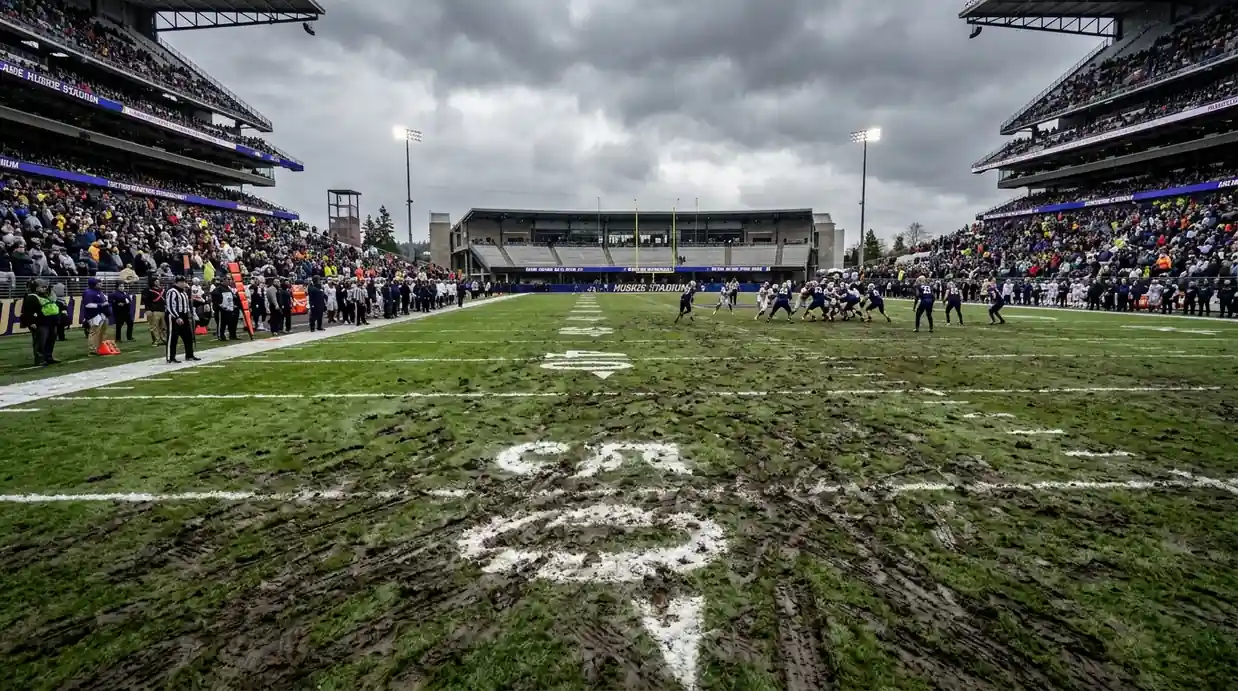
Buffalo, Cleveland, Green Bay, Chicago, Pittsburgh, Foxborough. Say those city names to any NFL bettor and the mental image is the same: snow, wind, freezing temperatures, miserable conditions. The sportsbook traders know this too, and they pre-adjust accordingly. Ed Salmons, VP of risk management at Westgate SuperBook, described it plainly: totals for games in historically bad-weather cities are set lower after Thanksgiving “just in case the weather is crappy.”
That pre-adjustment creates a specific challenge for weather bettors. If a sportsbook has already shaded Buffalo’s Week 14 total down by 1.5 points relative to what it would be if the game were played indoors, the weather information is partially — but not fully — priced in before you even check the forecast. The question becomes: how much of the expected weather impact is already reflected in the opening line?
My answer, after years of tracking this: about 60-70%. Books pre-shade enough to protect against the average late-season weather in these cities, but they do not pre-shade for the extremes. A December game in Buffalo might open with a total of 41 instead of the 44 it would carry if played in a dome. That 3-point reduction accounts for the typical December conditions: temperatures in the 20s, moderate wind, possible lake-effect snow. But if the actual forecast shows a full blizzard with 30 mph gusts and heavy accumulation, the total needs to drop to 36-37 to be fair, and the remaining 4-5 points of adjustment become the tradeable edge.
The inverse is equally important and less discussed. If a December game in Green Bay opens at 39 — reflecting the expected cold and wind — but the actual forecast shows an unseasonably mild 42 degrees with calm winds, the total is too low. The pre-shade is working against you in this scenario, creating over value in a game the public assumes will be a frozen slugfest. I have found these “warm surprise” games in bad-weather cities to be some of the most profitable over plays of the season, because the market’s prior expectation of harsh conditions is so deeply embedded that even a benign forecast does not fully correct it by kickoff.
For UK bettors, the baseline pre-adjustment is visible in the numbers themselves. If you track opening totals across the season, you will notice that outdoor late-season games in the six cities above open 2-4 points lower than equivalent matchups in domes or warm-weather cities. That built-in discount is the market’s weather premium, and knowing it exists allows you to focus your weather analysis on the differential: does the actual forecast justify more adjustment than the market has already made, or less?
Stay ahead of the bookmakers by checking the latest forecasts on Weather Impact on NFL Betting.
In-Play and the Impossibility of Perfect Pricing
In-play NFL markets on UK platforms are priced algorithmically. The models ingest score, time remaining, field position, and possession, then generate updated totals, spreads, and money lines in near real-time. What the models do not ingest — or ingest poorly — is weather.
I discovered this gap during a November 2022 game at Soldier Field in Chicago. Wind gusts intensified dramatically in the third quarter, climbing from a manageable 18 mph at kickoff to 32 mph by the start of the second half. The scoring pace, which had been consistent with a 42-point total through the first half, collapsed. The third quarter produced three punts, a fumble, and zero points. Yet the in-play total on two UK books I was monitoring barely moved — it adjusted for the scoreless quarter using its tempo model, but it did not account for the wind escalation that was causing the scoring drought.
The algorithm’s blind spot is understandable. Integrating real-time meteorological data into a live pricing engine is technically difficult and commercially unjustified for most operators. Weather shifts mid-game are infrequent enough that the edge cases do not warrant the engineering investment. But for bettors who are watching the game and monitoring weather conditions simultaneously, those edge cases are opportunities. When wind picks up dramatically mid-game and the in-play total has not adjusted, the under becomes a value play that the algorithm has not priced.
The reverse also applies. If heavy rain is forecast for the full game and both the pre-game total and the in-play model are depressed, but the rain actually stops at halftime and the wind drops, the in-play algorithm will be slow to recognise improved conditions. The over becomes the play, particularly on second-half totals, which some UK books offer as a standalone market. I have found second-half overs in games where weather clears mid-game to be a repeatable edge, albeit with a small sample size that demands modest bet sizing.
One practical note: if you are trading in-play weather on UK platforms, use the cash-out function with extreme caution. Cash-out prices on UK books are calculated using the same algorithm that is not properly accounting for weather, which means the offered price will undervalue your position if the weather shift is working in your favour. Let the bet ride rather than cashing out at an algorithmically depressed price.
Weather-Related Postponements and Void Rules
What happens to your bet if the weather gets so bad the game is postponed? This is a question UK bettors ask more often than American ones, partly because weather-related match postponements are common in English football and partly because UK gambling regulations handle voidance differently from Nevada or offshore jurisdictions.
NFL games are almost never postponed for weather. The league has played through blizzards, thunderstorms, and sub-zero temperatures with remarkable consistency. Lightning is the one exception — the NFL’s policy requires a minimum 30-minute delay when lightning is detected within eight miles of the stadium. If multiple lightning delays push the game past a reasonable completion time, the league can postpone to the following day. This has happened fewer than five times in modern NFL history, but it is the scenario UK bettors should understand.
Under Gambling Commission rules, UK sportsbooks must clearly state their settlement terms for postponed events. Most major UK operators follow a standard approach: if the game is completed on the same day, all bets stand. If the game is postponed to the following day, pre-match bets are typically voided unless the operator’s specific terms state otherwise. If the game is suspended mid-play and completed later, bets on the full game stand and are settled on the final result, while bets on specific halves or quarters may be voided depending on when the suspension occurred.
The practical implication for weather bettors is minimal, because the scenarios are so rare. But there is one edge case worth understanding: a game that starts in severe weather, is delayed by lightning in the first half, and resumes hours later in calmer conditions. Your pre-game under bet, placed on the expectation of weather-suppressed scoring, might settle against you because the majority of the game was played after the weather cleared. I have no strategy for this beyond awareness — it is an unhedgeable tail risk that occurs perhaps once every three to four seasons.
British Weather Services and the Bet365 History
The relationship between British weather forecasting and British bookmaking is older than most bettors realise, and it tells you something important about how seriously UK operators take meteorological data — just not for NFL.
Bet365 started as a single betting shop in Stoke-on-Trent in 1974, founded by Peter Coates. The company’s early edge was horse racing, and horse racing in Britain is weather-dependent in ways that make NFL look simple. Ground conditions — firm, good, soft, heavy — are determined by rainfall in the days before the race, and they fundamentally change which horses perform well. British bookmakers have been integrating meteorological data into their pricing models for horse racing since the 1980s, decades before American sportsbooks thought seriously about weather as a variable in NFL totals.
That heritage matters because the infrastructure exists. UK sportsbooks have weather data feeds, meteorological consultants, and risk models that incorporate environmental conditions. The question is whether they apply those tools to NFL markets, and the answer is: not consistently. Horse racing weather affects hundreds of races per week across multiple UK courses. NFL weather affects perhaps three to five games per week during a seventeen-week season. The commercial incentive to build bespoke NFL weather models is not strong enough for most UK operators, so they rely on the line import from the US market, where the weather analysis has already been done by the originating sportsbooks.
This creates an irony. UK sportsbooks have better weather analysis capabilities than their American counterparts in many respects — decades of experience, sophisticated Met Office partnerships, institutional knowledge from horse racing — but they do not apply those capabilities to NFL because the volume does not justify it. The bettor who bridges this gap, using British meteorological tools to analyse American football weather, is arbitraging between institutional capabilities and market application. An analysis of more than 13,000 NFL matches confirmed that wind and temperature are statistically significant predictors of scoring, yet most UK books still price NFL weather reactively rather than proactively.
The Met Office’s public API, available free for personal use, provides hourly forecasts at stadium-level granularity for London Games and can be combined with NOAA data for American venues. The technical barrier to building your own weather model is lower than most bettors assume. The competitive barrier is not knowledge — it is discipline: checking forecasts systematically, tracking line movement against weather data, and placing bets in the narrow windows where the UK line has not yet absorbed the information. Most bettors will not do this consistently. The few who do are the ones who capture the edge.
Frequently Asked Questions
How long does it take UK sportsbooks to adjust NFL lines for weather?
It varies by operator. The largest UK books with dedicated NFL trading teams update within 30-60 minutes of a US line move. Mid-tier operators using batch updates may lag by 2-4 hours. Smaller books relying on third-party risk management can be even slower. The lag creates a window where UK lines are behind the weather-adjusted market price.
When is the best time to bet NFL weather plays on UK platforms?
Wednesday through Thursday offers the best line value. Sharp US bettors begin acting when the seven-day forecast first shows adverse weather, and UK books often do not adjust until a day or two later. By Sunday morning, the weather information is fully priced in and the value has evaporated.
Do UK sportsbooks void NFL bets if a game is postponed for weather?
Under most UK operator terms, bets stand if the game is completed on the scheduled day. If postponed to the following day, pre-match bets are typically voided. NFL weather postponements are extremely rare — lightning delays are the most common cause, and full postponements have occurred fewer than five times in modern history.
Are in-play NFL totals on UK books adjusted for real-time weather changes?
Poorly, if at all. UK in-play pricing algorithms use score, time, and possession data but do not integrate live meteorological feeds. When conditions shift mid-game — wind intensifying or rain stopping — the in-play total adjusts slowly through tempo modelling rather than direct weather input. This creates brief windows of value for bettors monitoring conditions in real time.
Created by the ”Weather Impact on nfl Betting” editorial team.