NFL Prop Bets and Weather Conditions: Receiver, Rusher and Kicker Markets
 Available in US
Most weather-betting guides stop at totals and spreads. That is where the public bets and where the market adjusts fastest. But the sharpest weather edges I have found over the past five seasons sit in player prop markets — specifically receiving yards, rushing attempts, and kicker total points. These markets react to weather forecasts more slowly than totals, creating pricing gaps that persist well into the hours before kickoff.
CapperTek data shows quarterback fantasy production declining by 2.1 points per game in adverse weather conditions. That decline does not disappear — it flows downstream into every offensive skill position. Receivers catch fewer balls. Running backs get more carries. Kickers attempt fewer field goals and convert at lower rates. Each of those shifts creates a prop market that has not fully adjusted.
Receiving Yards and Wind
Receiving yards props are the most weather-sensitive individual market I track. In rainy conditions, teams average roughly 45 fewer passing yards, according to CapperTek analysis — and that aggregate decline distributes across individual receivers proportionally to their target share. A receiver who accounts for 30 percent of his team’s passing yardage can expect roughly 13 to 15 fewer receiving yards in rain, without any adjustment from the prop line.
Wind compounds the effect. At speeds above 15 mph, intermediate and deep routes become unreliable. Offensive coordinators shorten the route tree, which means each completion yields fewer yards even when the catch is made. A receiver whose average depth of target sits at 12 yards in clear weather might see that average drop to 8 in a wind game. His reception count may hold steady, but his yards per reception craters.
My approach: in confirmed bad weather (wind above 15 mph or moderate-to-heavy rain), I compare the posted receiving yards prop to my weather-adjusted estimate. If the prop has not moved down by at least the expected yardage reduction, I take the under. The adjustment is typically 10 to 20 yards for the team’s primary receiver and 8 to 12 for secondary options. These are not large numbers in absolute terms, but in a market where props are posted with half-yard precision, they create consistent value.
One important exception: short-area receivers — slot players and check-down running backs — are less affected by wind than boundary wideouts. Their routes stay below the altitude where wind disrupts the ball most severely, and their receptions are typically caught close to the line of scrimmage. If I am looking for a receiving yards over in a wind game (which is rare), it would be on a high-volume slot receiver rather than a deep-threat outside wideout.
Rushing Attempts Props
Rushing attempts are the mirror image of receiving yards in bad weather: where receiving production declines, rushing volume increases. At wind speeds above 25 mph, rushing backs average an additional 5 fantasy points per game, a figure driven primarily by increased carry volume rather than improved per-carry efficiency.
Rushing attempts props are offered by most UK-licensed sportsbooks, typically set at 15.5 to 19.5 for a starting running back depending on his team’s offensive profile. In a confirmed heavy-weather game, I add 4 to 6 attempts to my baseline projection for the lead back. If the prop sits at 17.5 and my adjusted projection is 22 to 23, the over is a strong play.
The key qualifier is backfield structure. This play works best for bellcow running backs who command 60 percent or more of team rushing attempts. For committee backfields, the additional volume is split between two or three players, diluting the effect on any individual prop. I check rushing share data from the current season before placing this bet — the backfield split is as important as the weather forecast.
Timing matters too. Rushing attempts props are typically posted later in the week than team totals, often on Friday or Saturday. By then, the weather forecast has solidified enough to identify genuine bad-weather games. I flag my rushing attempts targets on Wednesday when the first reliable forecasts emerge, then wait for the prop to be posted before comparing it against my adjusted projection. This lag between forecast visibility and prop availability is one of the structural advantages of the prop market over the totals market, where weather-driven adjustments appear faster.
The most profitable version of this bet targets games where a strong rushing team faces adverse weather conditions. A team that already runs the ball 30 or more times per game in clear weather may run 35 to 40 times in a blizzard, and the lead back’s prop has rarely accounted for that level of volume increase. The worst version targets pass-heavy teams that are unlikely to shift their offensive identity regardless of conditions. Some coaches simply refuse to abandon the pass, even when weather demands it, and their running backs do not see the volume uplift the data would predict.
Kicker Total Points
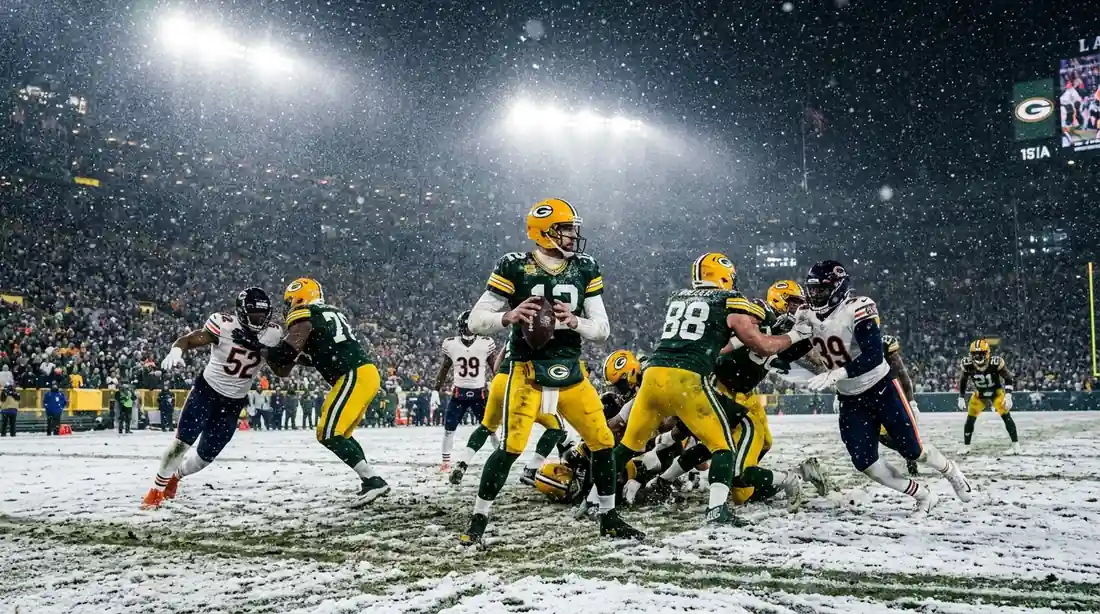
Kicker total points props are the most overlooked weather market. In a standard game, a kicker’s line might sit at 7.5 or 8.5, reflecting two field goals (6 points) and two extra points (2 points) as a rough baseline. In bad weather, two forces push the actual number downward: fewer field goal attempts (coaches go for it on fourth down more often or punt instead of attempting a 45-yarder in wind) and lower conversion rates on the attempts that do occur.
In snow games, field goal conversion drops from the league average of 83 percent to roughly 76 percent. In heavy wind, long-range attempts above 45 yards become unreliable enough that many coaches avoid them entirely. Yet kicker prop lines in weather-affected games typically move down by only 1 to 1.5 points from their baseline — a smaller adjustment than the data suggests is warranted.
My estimate is that the true expected kicker scoring in a heavy-weather game is 2 to 3 points below baseline rather than 1 to 1.5. That gap — roughly 1 point of mispricing — is small but consistent. Over a season with 15 to 20 heavy-weather games, it adds up. I bet kicker total points unders in every game where wind exceeds 20 mph or active snow is forecast, at standard stake size.
Anytime TD Scorer Shifts
Bad weather reshapes the touchdown-scorer distribution in predictable ways. Fewer touchdowns come through the air: receiving touchdowns decline because the passing game is compressed and red-zone fade routes — high-difficulty throws in ideal conditions — become near-impossible in wind or rain. More touchdowns come on the ground: the goal-line running back becomes the primary red-zone weapon, and quarterback sneaks increase in short-yardage situations.
For anytime-TD markets, this shift creates value in two directions. Running back anytime-TD prices should be shorter (lower odds, higher implied probability) in bad weather, but they often stay close to their clear-weather levels because the models generating them are weighted toward season-long data. Conversely, wide receiver anytime-TD prices should be longer (higher odds, lower implied probability), but they too lag the adjustment.
My standard play in confirmed bad weather is to back the lead running back’s anytime-TD at what I consider an inflated price, and to avoid receiver anytime-TD markets entirely. The running back benefits from increased volume, increased goal-line usage, and a defensive structure that is slightly less committed to stopping the run because the passing threat remains theoretically alive. These three factors compound to make goal-line backs the single most profitable anytime-TD selection in heavy-weather games.
Where the Prop Market Sleeps on Weather
Player prop markets are priced primarily on player talent, target volume, and defensive matchup. Weather is a secondary input — acknowledged but under-weighted. That hierarchy is correct for most games, because most games are played in benign conditions. But for the 15 to 20 heavy-weather games per season, the hierarchy inverts: weather becomes the dominant factor, and the markets that have not adjusted for it become the most profitable places to bet. Receiving yards unders, rushing attempts overs, kicker totals unders, and running back anytime-TD overs — these four plays, applied only in confirmed bad weather, have been my most consistent source of prop-market profit over four consecutive NFL seasons. The key is selectivity: only act when the weather is genuinely extreme, only target props where the adjustment gap is widest, and never force a weather bet when conditions are merely marginal.
Which prop market reacts slowest to a forecast change?
Kicker total points consistently adjusts least aggressively. Game totals and passing yards props move early in the week as sharp bettors act on weather; kicker props often remain close to their opening lines until hours before kickoff. This creates the widest pricing gap in the prop market for weather-aware bettors.
Do UK-licensed books offer the same NFL props as US books?
Most UK sportsbooks offer receiving yards, rushing yards, passing yards, and anytime-TD markets for NFL games. Rushing attempts and kicker total points props are less consistently available — some UK books carry them, others do not. Check your platform’s NFL prop menu early in the week to confirm which markets are open before building your weather-adjusted selections.
Written by the editors at Weather Impact on nfl Betting.