NFL Humidity Betting Impact: The Most Under-Studied Variable
 Available in US

Wind has its thresholds. Rain has its severity scale. Temperature has its scoring curve. Humidity has almost nothing. Of all the atmospheric variables that could plausibly affect an NFL game, humidity is the most under-studied, the least priced, and the most difficult to model. Only one of the top ten search results for NFL weather betting even mentions it. No major sportsbook adjusts lines for dew point or relative humidity. And yet anyone who has watched a September game in Jacksonville or Miami knows that the thick, saturated air does something to the players on the field — even if the data has not fully captured what that something is.
Why Humidity Rarely Shows in Models
The absence of humidity from NFL weather-betting models is not a mystery — it is a data problem. Wind speed, temperature, and precipitation are recorded consistently for every NFL game and have been for decades. Humidity and dew point are recorded by weather stations but are not included in the standard game-log datasets that most bettors and researchers use. If humidity is not in the dataset, it cannot appear as a feature in the model.
There is also a signal-to-noise issue. Ivetta Abramyan, the meteorologist and Bettor Weather co-founder, has cautioned that even with thorough analysis, “you still only have a handful of games that have been played that fit that specific criteria.” That warning applies with particular force to humidity. High-humidity games are concentrated in a narrow window — September and early October — and in a small number of venues (primarily Jacksonville, Miami, Houston when the roof is open, and New Orleans when the Superdome doors are open during pre-game). The sample of games played at genuinely extreme humidity levels is too small to produce statistically robust conclusions.
Additionally, humidity is confounded with temperature. High humidity occurs almost exclusively in hot conditions, which means any observed effect of humidity on game outcomes is entangled with the known effect of heat. Separating the humidity signal from the temperature signal would require a large sample of games played at, say, 85 degrees Fahrenheit with both low and high humidity — a sample that barely exists in the NFL’s outdoor game database because 85-degree games in low-humidity environments (like Denver) are rare.
The Early-Season Jacksonville and Miami Effect
Despite the data limitations, there is anecdotal and directional evidence that extreme humidity affects NFL games in specific ways. Jacksonville’s EverBank Stadium and Miami’s Hard Rock Stadium are the two venues most consistently associated with oppressive early-season heat and humidity. September games at these venues routinely feature kickoff dew points above 70 degrees Fahrenheit (21 degrees Celsius) and relative humidity above 80 percent.
The observable effects in these games are concentrated in the second half. Visiting teams that are not acclimatised to subtropical conditions show visible fatigue in the third and fourth quarters: slower defensive rotations, more substitution packages to rest starters, and higher rates of cramping and heat-related medical stoppages. The Dolphins and Jaguars have historically performed well in September home games, and while home-field advantage is a complex phenomenon, the humidity component is consistently cited by coaches and players as a meaningful factor.
For bettors, the early-season Florida effect has two potential applications. First, second-half live totals: if visiting teams tire more rapidly in high humidity, the second half may produce fewer combined points than the first, because offensive execution degrades as fatigue sets in. Second, team totals: the home team, which is acclimatised, may maintain or increase its scoring rate while the visiting team’s rate declines, creating value on the home team total over and the visiting team total under.
I have tracked second-half scoring splits in high-humidity games (dew point above 68 degrees Fahrenheit) over four seasons. The sample is small — roughly 20 to 25 qualifying games per season — and the results are suggestive rather than conclusive. Second-half scoring in high-humidity games is approximately 1.5 to 2 points lower than in comparable games with lower humidity, but the confidence interval is wide enough that I treat this as a supplementary lean rather than a primary betting thesis.
Humidity vs Fatigue in the Second Half
The central challenge in modelling humidity’s impact is distinguishing it from fatigue that would occur regardless of atmospheric conditions. NFL players are fatigued in the second half of every game — that is a universal feature of a 60-minute contact sport. The question is whether high humidity accelerates that fatigue beyond the baseline level, and by how much.
The physiological mechanism is well understood from exercise science even if it has not been rigorously quantified in the NFL context. High humidity impairs the body’s ability to cool itself through evaporation. When sweat cannot evaporate efficiently, core body temperature rises faster, cardiovascular strain increases, and muscular performance declines. These effects compound over the duration of a game, which is why the impact is more visible in the second half than the first.
For pass-catchers and defensive backs who run the most during a game, the humidity penalty should theoretically be largest. A receiver who runs 25 to 30 routes in a game expends enormous energy, and impaired thermoregulation would degrade his route-running sharpness, concentration on contested catches, and burst speed on separation routes. If this degradation is real and measurable, it would show up as a decline in receiving yards and contested-catch rate in the second half of high-humidity games — but that signal has not been isolated in any analysis I have seen.
Tracking It Yourself
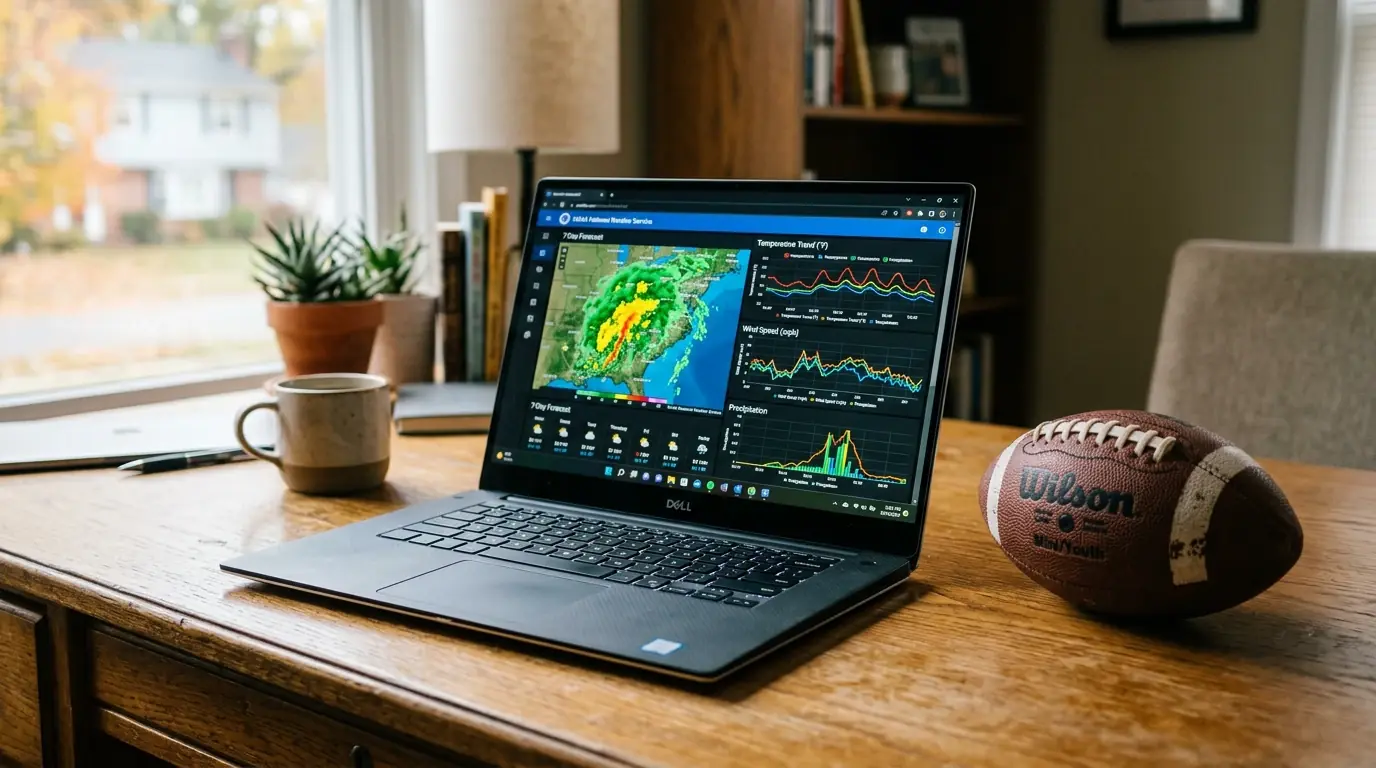
If you want to explore the humidity angle in your own analysis, the data is available. NOAA’s hourly weather observations include relative humidity and dew point for stations near every NFL stadium. Cross-referencing those readings with game-by-game scoring data from publicly available databases gives you the raw material to test whether humidity adds predictive value to your model.
My recommendation: start with dew point rather than relative humidity. Dew point is a more stable and physically meaningful measure of atmospheric moisture than relative humidity, which varies with temperature throughout the day. A dew point above 68 degrees Fahrenheit (20 degrees Celsius) is the threshold where most exercise physiologists consider conditions “oppressive” for sustained physical activity. Flag games above that threshold and track whether your scoring model’s accuracy improves with a humidity adjustment.
After four seasons of tracking, I have not found a strong enough signal to make humidity a standalone betting factor. But I have found enough directional evidence to include it as a supplementary variable in my September and early-October analysis. If the rest of my model already leans toward the under on a high-humidity game — because of wind, temperature, or matchup factors — the humidity reading provides modest confirmation. It is an edge sharpener, not an edge creator.
The Variable That Is Waiting for Its Researcher
Humidity is the last major atmospheric variable without a robust NFL betting model. Wind, rain, snow, and temperature have all been studied, quantified, and (to varying degrees) priced by the market. Humidity sits in a gap between anecdotal observation and statistical confirmation, lacking the sample size and the dataset integration needed to produce actionable thresholds. The bettor who eventually fills that gap — with a multi-season dataset, proper controls for temperature and venue, and a focus on dew point rather than relative humidity — will have a genuine first-mover advantage in a market that has not yet learned to price this variable.
Should humidity change my second-half live total bet?
Only as a supplementary factor. If you are already leaning toward a second-half under based on other variables (defensive matchup, game script, wind), a high dew point above 68 degrees Fahrenheit adds modest confirmation. It should not be the sole basis for a live bet because the sample of high-humidity NFL games is too small to produce reliable standalone signals.
Is there a humidity threshold like 20 mph for wind?
Not yet. Wind has well-established thresholds (15 mph, 20 mph, 25 mph) because the data is robust and the effects are large. Humidity lacks equivalent thresholds because the sample is small and the effects are modest. A dew point of 68 degrees Fahrenheit is the closest approximation to a meaningful threshold based on exercise physiology, but it has not been validated against NFL scoring data with statistical rigour.
Published by the Weather Impact on nfl Betting team.