NFL Altitude and Denver Betting: A Mile-High Companion to Weather Analysis
 Available in US
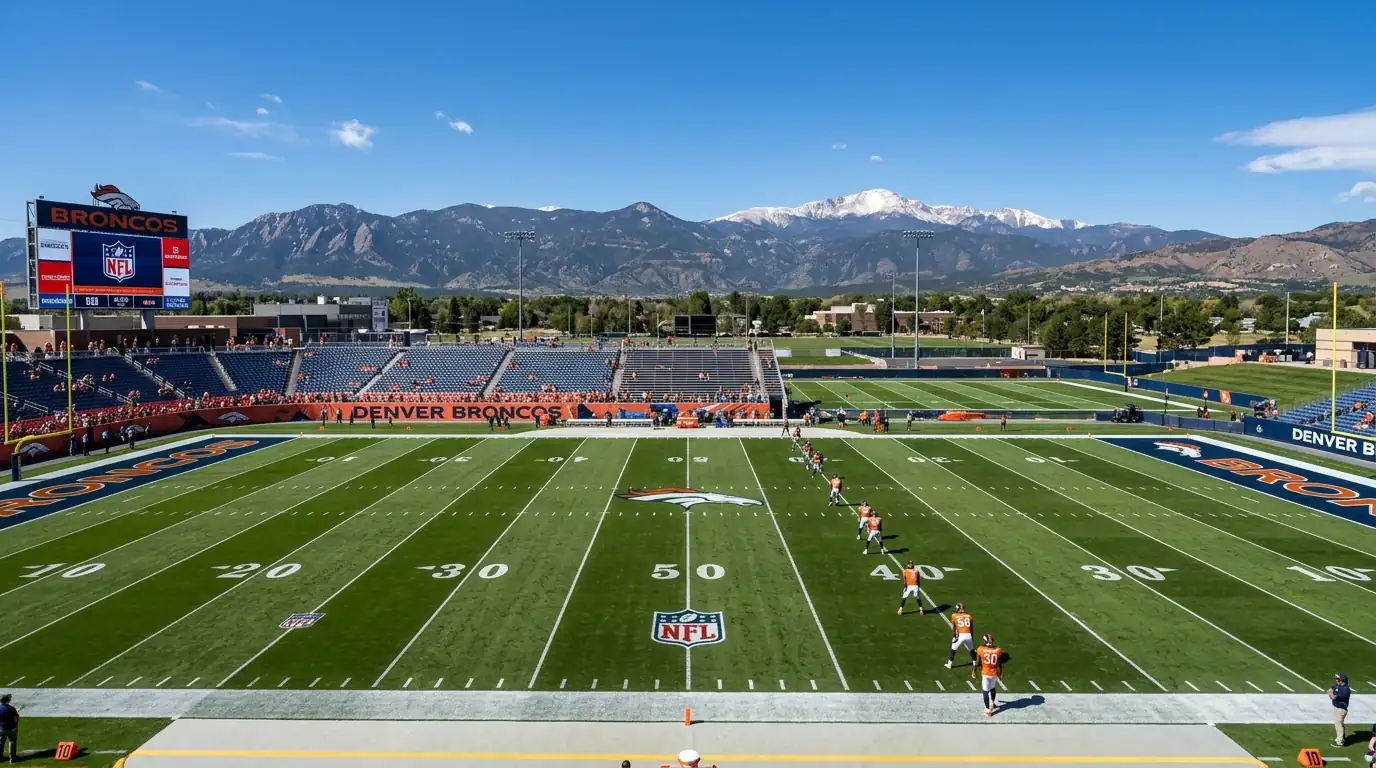
Altitude is not weather. It does not change from day to day, it cannot be forecast, and no front or storm system will suddenly lift Denver’s Empower Field at Mile High from its fixed position at 5,280 feet above sea level. But altitude interacts with weather in ways that make it impossible to separate from a comprehensive NFL environmental analysis, and its effects on game outcomes are large enough that any bettor ignoring them is leaving value on the table.
This article examines how Denver’s elevation affects ball flight, kicking, visitor performance, and — critically — how those effects compound when altitude meets cold weather in the second half of the NFL season.
5,280 Feet and Ball Flight
At sea level, air density is approximately 1.225 kg per cubic metre. At 5,280 feet, it drops to roughly 1.048 kg per cubic metre — a reduction of about 14 percent. That thinner air has two measurable effects on a thrown or kicked football: reduced aerodynamic drag and reduced Magnus force (the spinning effect that causes a spiral to stabilise in flight).
The drag reduction means the ball travels farther. A quarterback’s deep throw that would travel 52 yards at sea level will travel approximately 54 to 56 yards in Denver under the same throwing force. A punt that would carry 45 yards at sea level will carry 47 to 48. And a field goal that would just clear the crossbar from 50 yards at sea level will clear it with 2 to 3 yards of margin in Denver.
The reduced Magnus force is less intuitive but equally important. A spiral that is slightly off-axis will wobble more in thin air because the stabilising effect of spin is diminished. This means that while well-thrown passes gain distance, poorly thrown passes are punished more severely — the ball ducks, sails, or wobbles in ways that would be partially corrected by thicker air at lower elevations. The result is a wider variance in passing outcomes: more completions on well-thrown deep balls, more incompletions on marginal throws.
For totals bettors, this variance is important. Denver games tend to produce slightly higher scoring on average than comparable sea-level games — not because the offences are better, but because the aerodynamic conditions favour long completions and field goals. The question is whether the posted total already accounts for this, and the answer is usually yes: sportsbooks have decades of Denver scoring data and apply an altitude adjustment to their opening lines. The value for bettors lies not in the altitude effect itself but in the interaction between altitude and other variables that the line may not fully capture.
Kicker Distance Uplift
The kicking game is where altitude’s effect is most cleanly measurable. NFL kickers in Denver consistently attempt and convert field goals at longer distances than their peers at sea-level venues. The league’s historical data shows that field goal attempts of 55 yards or more are roughly twice as common in Denver as at the average NFL stadium, and conversion rates on long-range attempts are materially higher.
The physics are straightforward: reduced air density means less resistance on the ball’s trajectory, allowing it to maintain height and distance over longer flights. A kicker who can barely reach from 55 yards at sea level can comfortably reach from 58 to 60 in Denver. Coaches know this, which is why fourth-down decisions at Mile High favour the field goal attempt at distances where coaches at other venues would punt or go for it.
For kicker prop bettors, Denver games present a distinctive opportunity. Kicker total points props at Mile High should theoretically be set higher than the same kicker’s props at a sea-level venue, because more field goal attempts are expected and conversion rates are higher at every distance. In practice, the adjustment is often modest — the prop is set based on the kicker’s season average rather than a venue-adjusted projection. When a kicker travels to Denver, his total points prop may be underpriced by 1 to 2 points relative to the altitude-adjusted expectation.
The same logic applies to team total props. If the kicking game is more productive in Denver (more attempts, higher conversion, longer makes), the home and away team totals should both reflect a slight uplift from field goal contributions. This is a small edge — perhaps half a point to one point per team — but it is systematic and persistent because it is driven by physics rather than game-to-game variance.
Visitor Fatigue Evidence
The most debated aspect of Denver’s altitude advantage is the visitor fatigue effect. The claim is that teams visiting Mile High experience reduced cardiovascular capacity due to the lower oxygen concentration at 5,280 feet, leading to faster exhaustion and degraded performance in the second half. The evidence for this claim is mixed.
On the supporting side: visiting teams have historically performed worse in the second half at Denver than at other neutral-altitude venues, with a particularly pronounced effect in the fourth quarter. The Broncos’ home record is among the best in the NFL, and their fourth-quarter point differential at home exceeds their overall home-field advantage — consistent with a fatigue effect that compounds over the course of a game.
On the sceptical side: the Broncos’ home-field advantage correlates closely with the quality of their roster, which has been above average for most of the franchise’s history. When the Broncos have been bad (as in several recent rebuilding years), the home-field advantage has narrowed, suggesting that altitude is a secondary factor behind roster quality. Additionally, modern NFL teams employ altitude-preparation protocols (arriving in Denver early, using supplemental oxygen on the sideline) that may mitigate the physiological effect.
My assessment: altitude contributes to visitor fatigue but is not a dominant factor. The effect is worth roughly 0.5 to 1 point of additional home-field advantage above and beyond the standard 2.5 to 3 points that sportsbooks apply to home teams. Most lines at Mile High already incorporate this adjustment, so the visitor-fatigue angle is rarely a standalone edge. It becomes more interesting when combined with weather effects.
When Altitude Meets Cold Weather
Denver’s most interesting games for weather bettors are the late-season fixtures when altitude combines with cold temperatures. Data from Sharp Football Analysis indicates that temperatures above 85 degrees Fahrenheit (29 degrees Celsius) or below 25 degrees Fahrenheit (minus 4 degrees Celsius) reduce NFL scoring by approximately 8 percent. In Denver, those cold-temperature effects may be amplified by two additional factors.
First, cold air at altitude is even thinner than cold air at sea level. Air density decreases with both altitude and cold (cold air is denser than warm air, partially offsetting the altitude effect, but not fully). The net result is that Denver’s thin air becomes only marginally denser in cold weather, maintaining the aerodynamic conditions that favour long field goals while introducing the grip, ball-hardness, and muscle-stiffness penalties that cold weather imposes at any altitude.
Second, Denver’s dry climate means that cold weather in Denver is qualitatively different from cold weather in Buffalo or Green Bay. Denver’s cold is dry cold — minimal humidity, minimal precipitation, often clear skies. The contrast with lake-effect snowstorms in Buffalo or the howling wind at Lambeau is stark. Dry cold degrades grip and ball feel but does not introduce the passing-game chaos of wind-driven snow. This means that Denver cold-weather games may actually produce higher totals than equivalent-temperature games at sea-level cold-weather venues, because the precipitation-and-wind penalty that drives most cold-weather scoring suppression is absent.
I apply a smaller total adjustment for Denver cold-weather games than for equivalent-temperature games at Highmark, Soldier Field, or Gillette Stadium. If my standard cold-weather model suggests a 3-point total reduction for a 22-degree game, I reduce that to 1.5 to 2 points for Denver because the altitude-driven ball-flight advantage and the absence of precipitation partially offset the cold-temperature penalty.
A Mile Above the Standard Model
Denver is the NFL’s atmospheric outlier. Every other variable in weather-betting analysis — wind, rain, snow, temperature — applies uniformly across venues, adjusted only for stadium geometry. Altitude applies to exactly one stadium. That uniqueness makes it easy to overlook and hard to model, but the effects on ball flight, kicking, visitor fatigue, and cold-weather scoring are real and worth incorporating into any comprehensive NFL environmental framework. The adjustment is not large. But in a market where edges are measured in fractions of a point, a venue-specific calibration for the one stadium at 5,280 feet is worth the ten minutes it takes to apply.
Is the Denver altitude edge already in the spread?
Mostly, yes. Sportsbooks apply a home-field advantage adjustment of roughly 3 to 3.5 points for Denver, slightly above the league average of 2.5 to 3 points. That extra half-point to one point reflects the altitude factor. The edge for bettors is not in the altitude itself but in the interaction between altitude and game-day weather, which the line may not fully capture.
Does altitude amplify or dampen cold weather effects?
It dampens them slightly. Denver’s cold weather is typically dry, with minimal wind and precipitation. The ball-flight advantage from thin air partially offsets the cold-temperature scoring penalty. Cold-weather games in Denver tend to produce higher totals than equivalent-temperature games at sea-level venues like Buffalo or Green Bay, where cold is accompanied by wind and snow.
Created by the ”Weather Impact on nfl Betting” editorial team.